The loop: one 15-minute bar in, one indicator change out
TradingView to a grader to my phone to TradeZella to a weekend test and back to the chart. No results yet; this is the machinery.
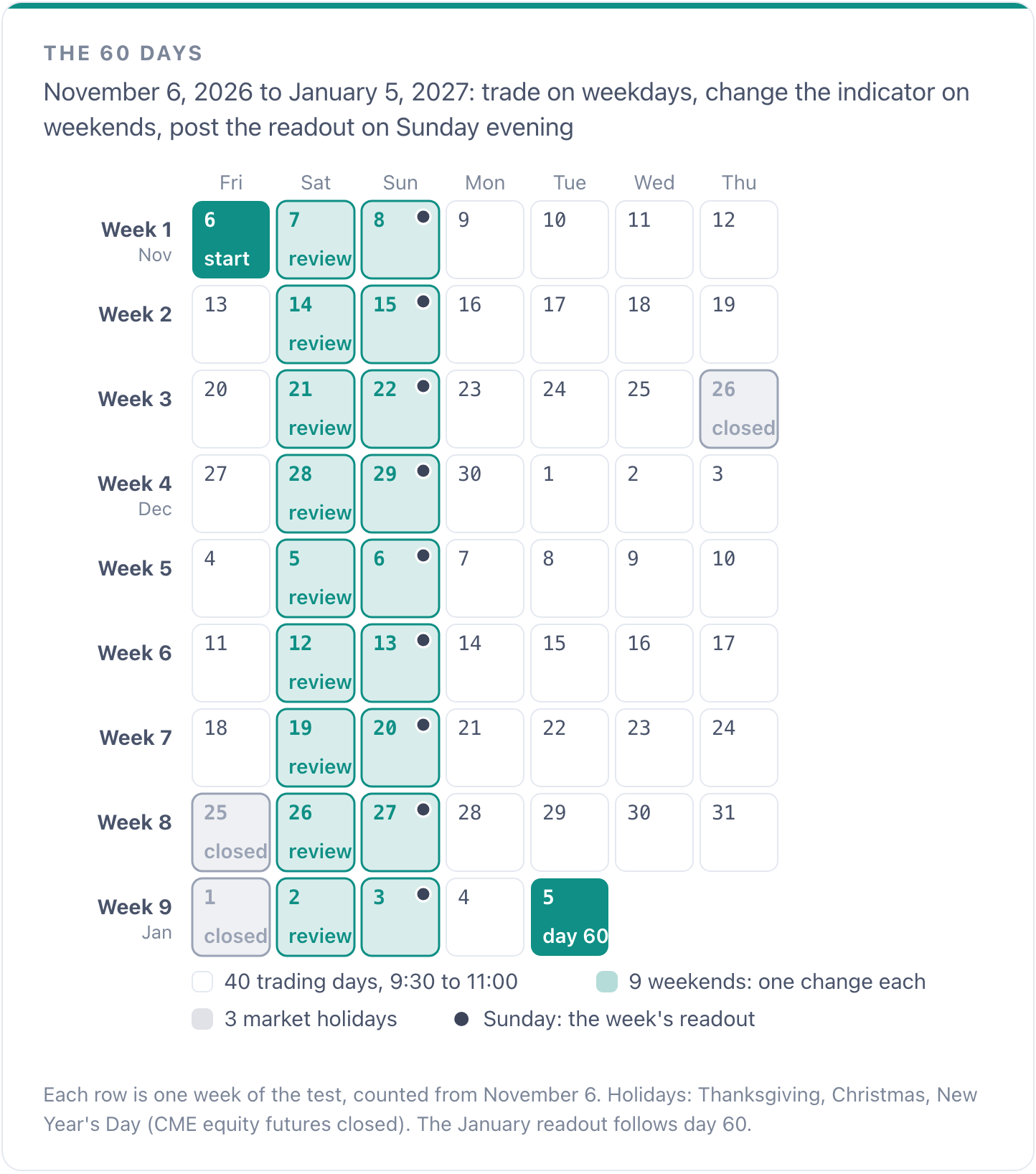
Day one of the $2,400 test was today, November 6. I have no trades to show you. The journal is empty since the test started, and the only thing that has gone through the pipe is a dry run with the model switched off.
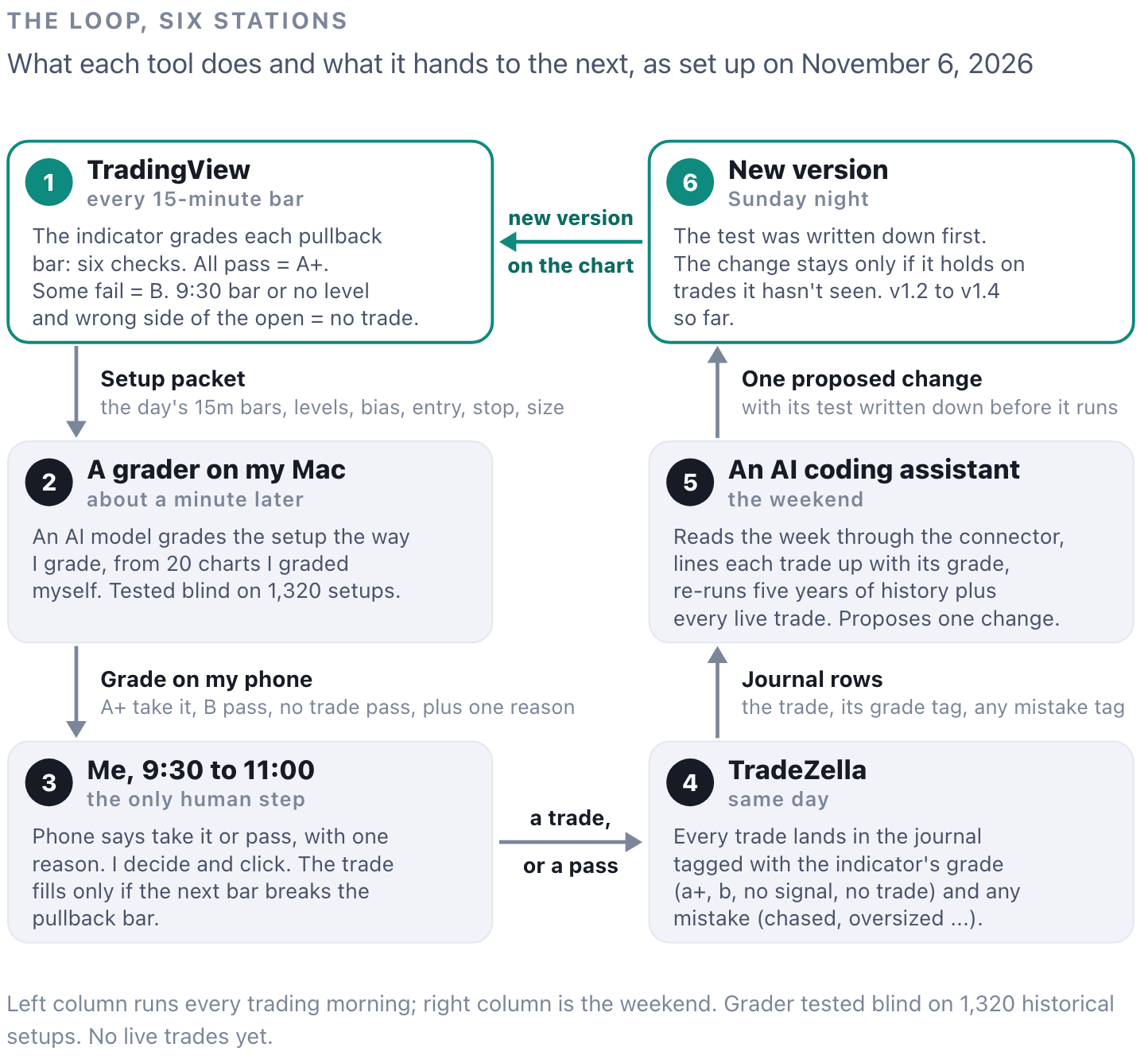
So this post is the machine. One drawing, then a walk round it, station by station.
New posts land on Substack first. Free, one a week. The $20k test has a scoreboard, updated every Sunday.
Subscribe on Substack1. The chart grades the bar
On the 15-minute MNQ chart, the indicator looks at every pullback bar as it closes and runs six checks: bias, 15-minute higher low, a level at or above the opening print, a close over the opening print, a stop that fits, and the candle itself. All six pass and it marks A+. Some fail, B. The 9:30 bar, or no level and the wrong side of the open, no trade.
An A+ only becomes a trade if the next bar takes out the pullback bar's high. The kickoff post listed five checks. The sixth is new, and it's the best example I have of the loop working, so it gets its own section below.
2. A grader on my Mac, then my phone
With grading switched on, each A+ fires an alert whose message is the whole setup as data: the day's 15-minute bars from 6:00, the nearby levels, the bias, the entry, the stop and the size. TradingView posts it to a small service running on my Mac.
The service hands the setup to an AI model with one job: grade it the way I grade. It sees 20 charts I graded myself, with my notes next to them, things like "need red candle" and "Good setup even though it didn't pay". It grades the setup, not the result.
It graded 1,320 historical setups blind; the 95 it called A+ averaged +0.17R. R is what I risk to the stop. The same caution as last post applies: that's a hint from under 100 trades, not an edge.
About a minute after the bar closes, my phone says take it or pass, with one reason. Cost per graded setup, five to ten cents. At A+ only, that's one or two a week.
3. I click
The grade is advice. I decide, I click, or I pass. The hard rules don't move: $1,000 max loss per account per day, 5 MNQ max, done at 11:00.
This is the only step a person touches.
4. The journal gets the tag
Fills land in my two funded accounts, which sync into TradeZella. Each trade then gets a tag from a category I made for this test, Indicator grade: a+, b, no signal (the indicator drew nothing) or no trade (it drew the cross). Plus any mistake tag: outside window, oversized, past daily stop, not in plan, chased.
The mistake tags are the discipline line on the scoreboard. If they don't go down week by week, the loop failed at the human step, whatever the P&L says.
5. The weekend: one change, test written first
On Saturday an AI coding assistant reads the week through the TradeZella connector and the grader's log. It lines each trade up with what the indicator said and what the grader said. Then it re-runs the tests: five years of MNQ history, August 2021 to July 2026, plus every live trade so far.
It proposes one change. The test is written down before it runs. That's how the exit study and the news-day study were done, and both came back no, which is the point of writing it down first.
Nothing changes the indicator except a test it passed on trades it hadn't seen.
6. The new version goes back on the chart
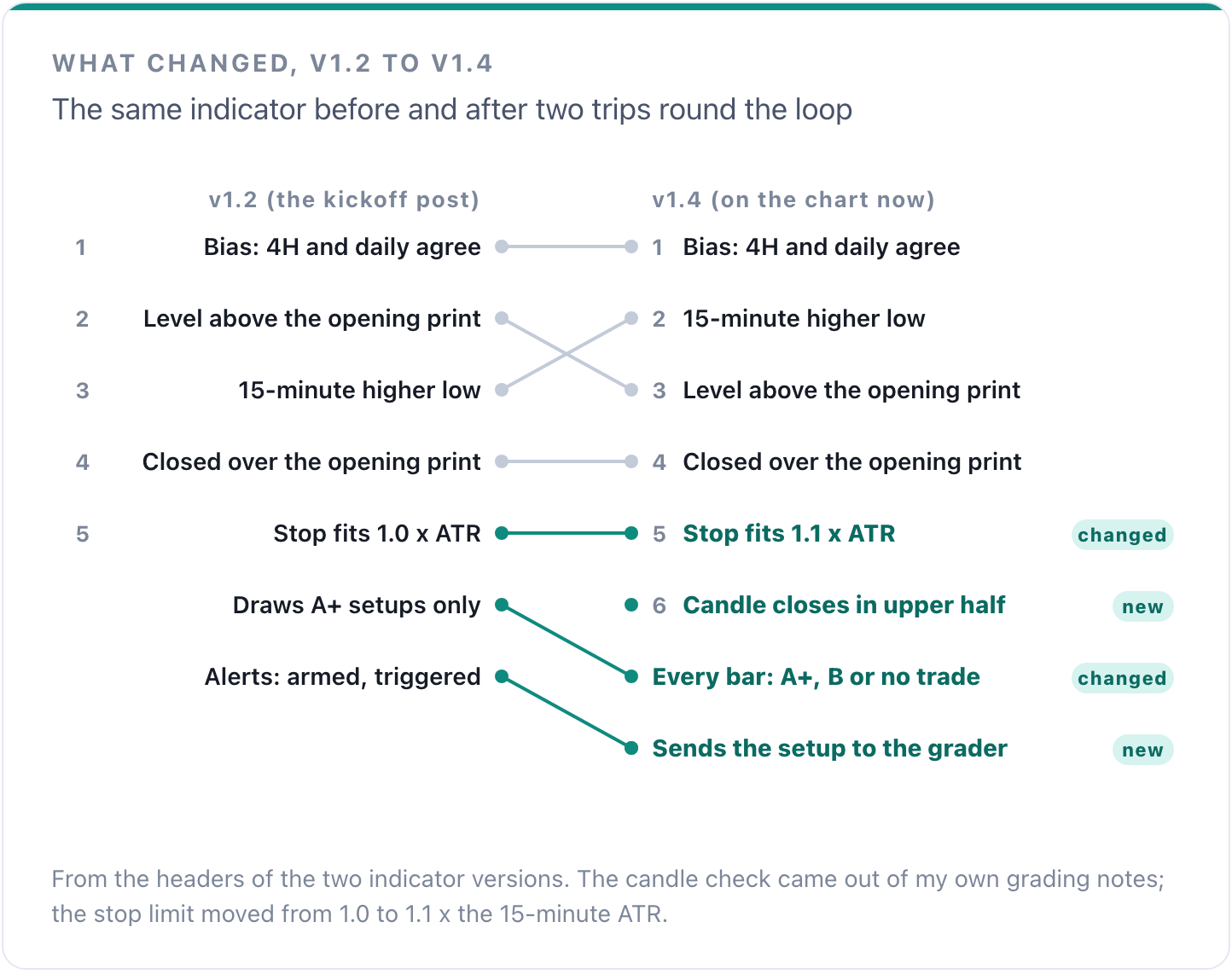
This has already happened. The kickoff post described v1.2: five checks, A+ setups drawn and nothing else. v1.4 is on the chart now. It grades every bar A+, B or no trade, allows a stop up to 1.1 times the 15-minute ATR (average true range, the typical size of a bar) instead of 1.0, adds the candle check, and sends the setup to the grader.
The candle check followed a round of grading my own charts. I kept marking setups down for the wrong colour of pullback bar, shorts on a green candle, longs on a red one. Once I'd written "need red candle" enough times, the rule went into the code: the pullback bar has to close in the half of its range that points your way.
What I can't show you yet
Results. Zero live trades. Zero real grades. Today's run was end to end with no model behind it, to check the wiring. The first real grades come when the market opens next week, and the first weekend review is November 7, with nothing in it to review.
That's fine. The scoreboard was written before the first trade so that this wouldn't matter. In early January I read it out.
Next: the first dated readout, in early January.
New posts land on Substack first. Free, one a week. The $20k test has a scoreboard, updated every Sunday.
Subscribe on Substack