The $20k test: scoreboard
One indicator, one instrument, two months, $20,000. Written November 8, 2026, before the first trade. Updated every Sunday.
This is the page I update. Every Sunday at 19:00 Eastern the numbers below change. The rules on it do not.
On November 8, 2026 I replaced the $2,400 test with this one. Same money, same kind of accounts, a different indicator and a number on the wall. The post I'm changing the test says why.
New posts land on Substack first. Free, one a week. The $20k test has a scoreboard, updated every Sunday.
Subscribe on SubstackThe four lines
- One indicator. The balance zone around yesterday's close, version 1: no level trades while price is inside it. The width comes from the VIX. The version on the chart is frozen for the test; a change needs a written test first and goes in the changelog below.
- One instrument. MNQ, the micro Nasdaq future.
- Two months. November 9, 2026 to the close on Friday, January 8, 2027. Forty-two trading days.
- One number. $20,000 of realized profit across prop accounts, measured at the close on January 8. Payouts received plus balance above start on open accounts. Evaluation balances do not count until the account is funded.
Reaching $20,000 is a yes. Spending the full $2,000 of the payout on evaluations is a no, whatever the rest says. Anything in between, I say the number.
The money
The same $2,400 payout, in its own account. Less than $2,000 of it buys evaluations at about $150 each. The firm, the account size and the number of accounts running at once go here when I buy the first one. The hard rules do not move: $1,000 max loss per account per day, 5 MNQ per trade. The window is wider than my usual two hours for the test: entries until 15:30, flat by 16:10.
The tally
Day 0, written November 8, 2026 before the market opened on Monday.
| reading | value |
|---|---|
| trading days done | 0 of 42 |
| signals outside the zone | 0 |
| trades taken | 0 (n = 0) |
| trades taken inside the zone (rule breaks) | 0 |
| wins / losses | 0 / 0 |
| net realized, all accounts | $0 |
| distance to $20,000 | $20,000 |
| evaluations bought / passed / failed | 0 / 0 / 0 |
| spent on evaluations | $0 of the $2,000 cap |
The starting line
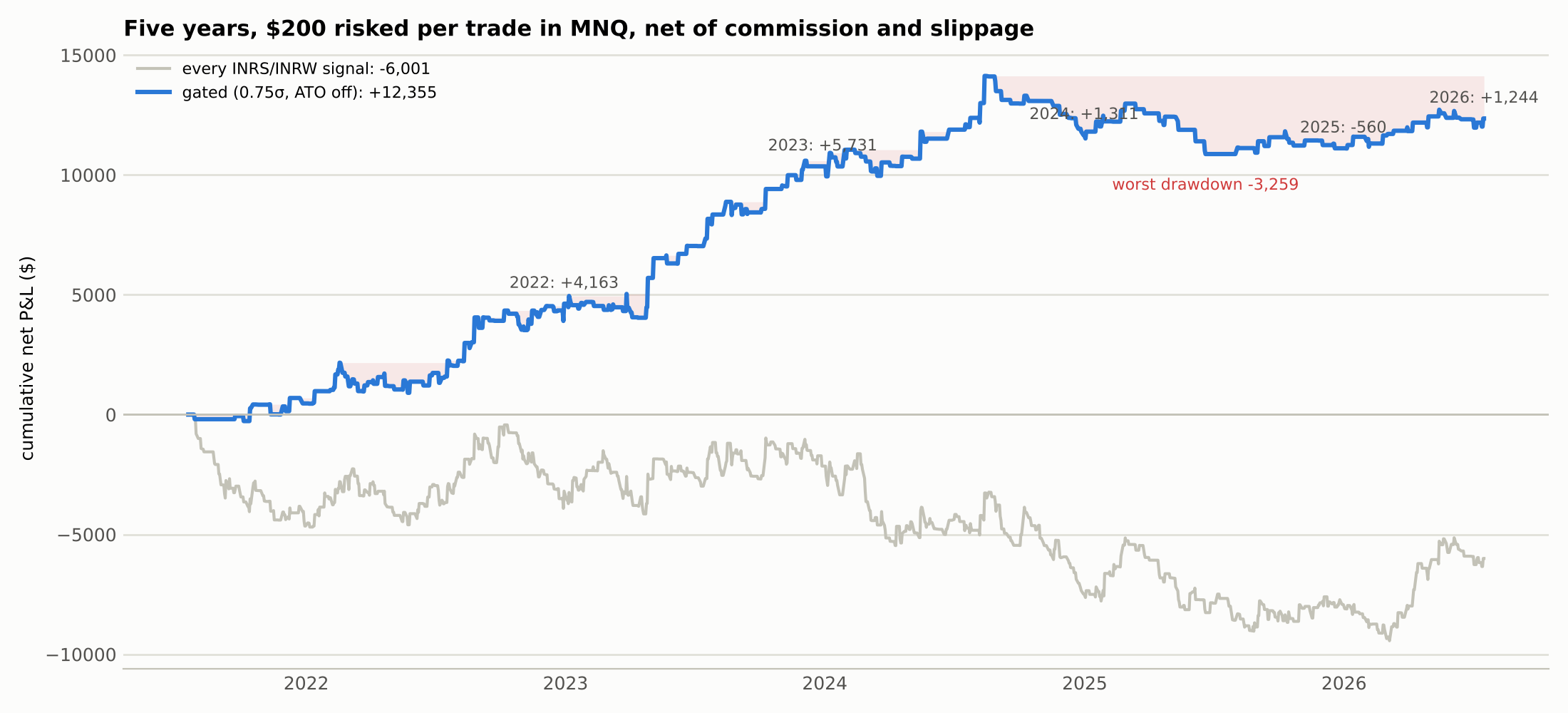
Five years of the same level setups, as fixed rules on MNQ, at $200 risk a trade: every signal taken ends down about $6,000; signals taken only outside the zone end up about $12,000, positive in every year, worst drawdown about $3,300. About two trades a week. Found looking backward on the same five years, so it is a starting line, not a result. The first real test is the months the backtest never saw.
What the rule looks like on real sessions: nine pictures of the rule.
How the test gets better week to week, and why profit can't be the yardstick in two months: Thirteen trades won't tell me if it works. Following the rules will.
First reading on months the backtest never saw
Scored November 8, 2026 on the 79 sessions from July 20 to November 6, 2026, which no backtest or search had touched. Same engine, same setups, every signal versus the zone rule at three widths.
| rule | trades | avg R | win rate |
|---|---|---|---|
| every signal | 67 | +0.08 | 27% |
| zone at 0.5 sigma (the pre-registered width) | 39 | -0.01 | 28% |
| zone at 0.75 sigma (the width I trade) | 26 | +0.22 | 35% |
| zone at 1.0 sigma | 19 | +0.13 | 32% |
On this stretch the rule at its pre-registered width did not beat taking every signal, and the three widths are not in order. Twenty to forty trades cannot call it either way; a real answer needs about 140. It is the first mark against the rule, and it goes here because it happened.
The changelog
Every change to the indicator goes here with the test written before it ran and the verdict after. Nothing proposed yet.
How to follow
- Sunday, 19:00 Eastern: the week's readout as a post. The tally above with n, one chart, what I got wrong.
- Mondays: the series posts, starting with how I draw the zone before the open.
- This page carries the running totals. The Substack post of November 9 carries the starting line as it was written.
Next: I'm changing the test. One indicator, one instrument, two months, $20,000.
New posts land on Substack first. Free, one a week. The $20k test has a scoreboard, updated every Sunday.
Subscribe on Substack