$500 a day is a lot of money
What a $10,000 day costs in size, and what it does to a payout.
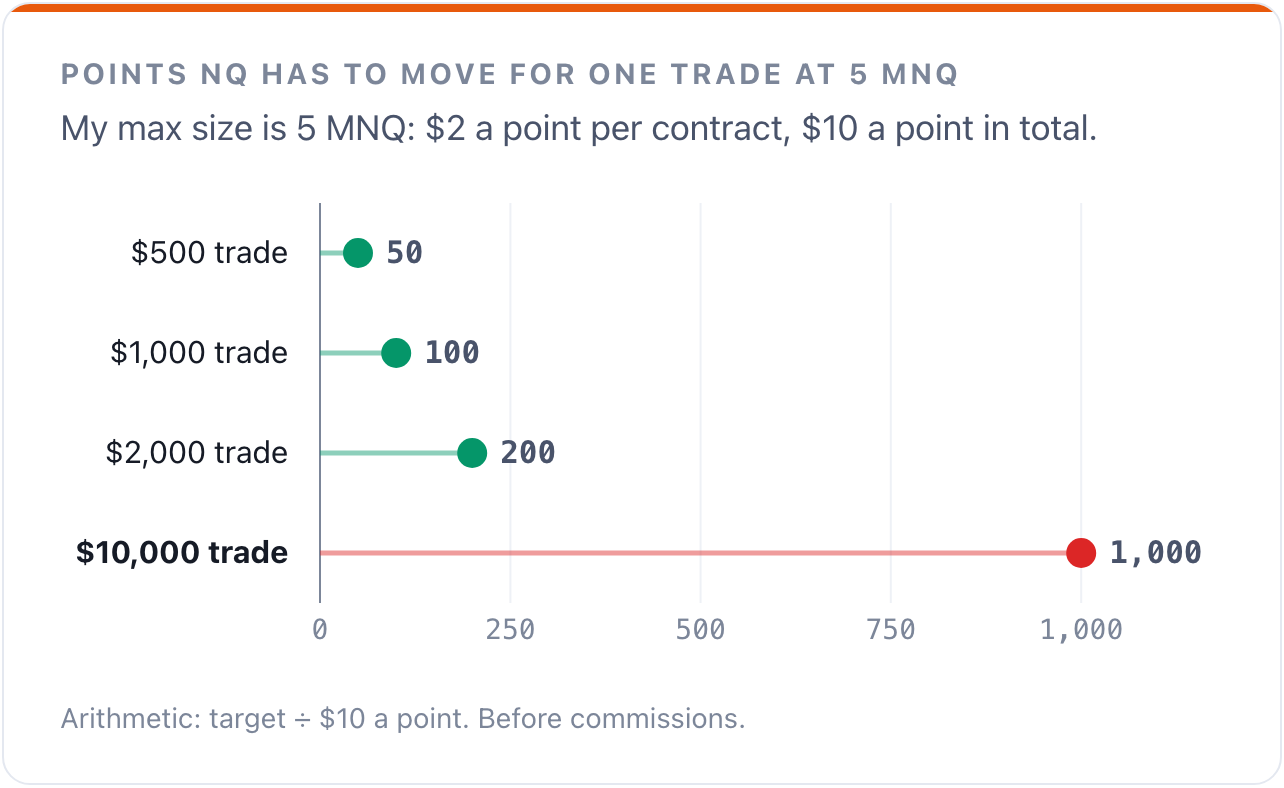
My max size is 5 MNQ. At $2 a point per contract, that's $10 for every point NQ moves my way. A $500 trade needs 50 points. A $10,000 trade needs 1,000.
When someone says they're going for a $10,000 day, what I hear is that they're about to size up.
New posts land on Substack first. Free, one a week. The $20k test has a scoreboard, updated every Sunday.
Subscribe on Substack$10,000 is a lot of money too
$10,000 is more than a lot of people have saved. Why try to make $5,000 or $10,000 on every trade if that amount would be a big part of your bankroll? One mistake is a big part of your bankroll too.
A prop account makes it worse. On a Tradeify 50K eval, as of August 2026, the whole trailing drawdown is $2,000. Size up far enough for a $10,000 trade and one stop-out can end the account.
Be excited by $500, $1,000 and $2,000 days, and repeat them until you reach $100,000, then $1 million.
The payout rules pay the small days
Tradeify's funded account (as of August 2026) puts two rules between you and a payout.
- Five qualifying days. Each one needs more than $150 of profit, counted since your last payout. I wrote about what that does to traders who size too small in You can be too small to get paid.
- A 35% consistency rule. Your best day can be at most 35% of your profit since the last payout.
Turn the second rule around and it tells you how much total profit one day needs behind it before you can get paid. Divide the day by 0.35.
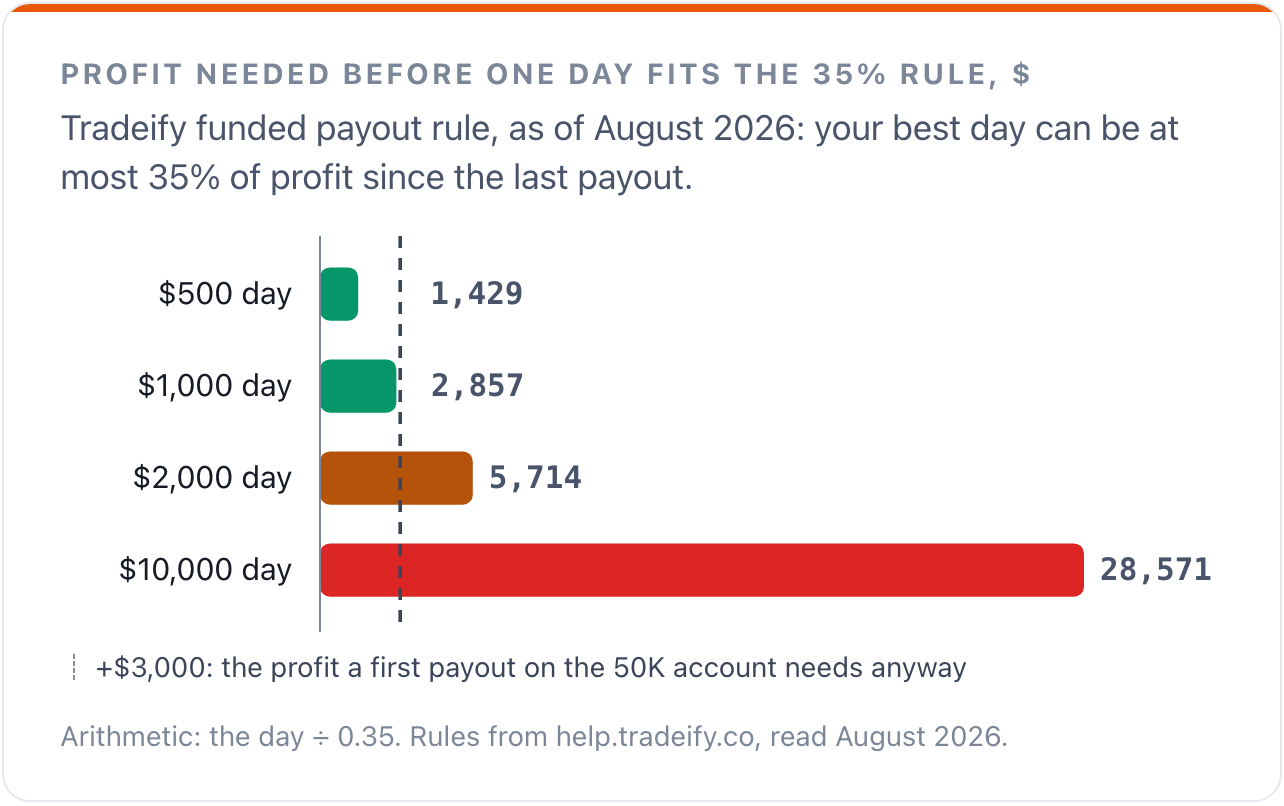
You need +$3,000 for a first payout anyway, so a $500 or $1,000 day never slows you down. A $10,000 day means making another $18,571 before you can ask for a dollar.
Five $500 days clear the $150 bar five times, and none of them is too big. That's the kind of trading these rules pay.
How fast small days add up
This part is plain multiplication, not a promise.
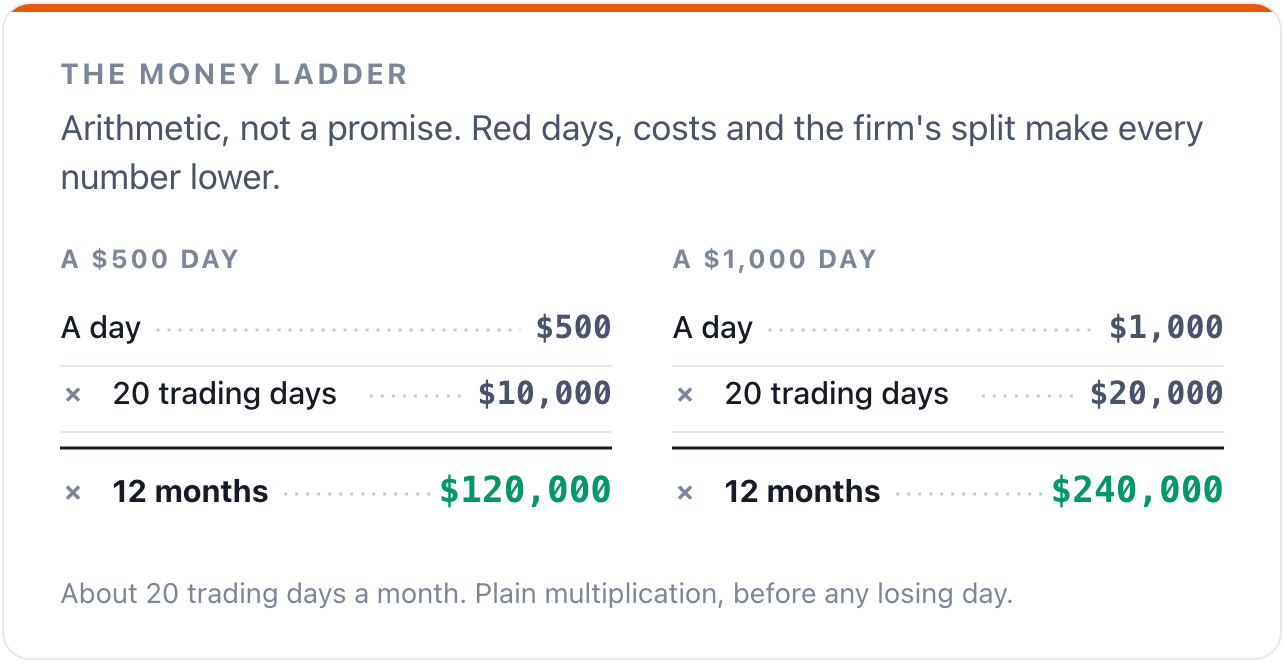
Real months have red days, so every number in that table comes out lower. Even so, the $500 row gets past $100,000 in a year on paper. A $10,000 day either happens once, or it takes the account with it and you start over with a new eval.
Stacking $500 days only works if the account is still open next month, and 5 MNQ is how mine stays open.
What I do now
- I count a $500 day as a win, not a warm-up.
- My size stays the same on mornings I feel like swinging for a big one. That feeling is the warning.
- I size to the account's rules: big enough that a winning day clears $150, small enough that one loser leaves the drawdown alone.
- I watch the running total, not the best day.
Next: Wait for the higher low
New posts land on Substack first. Free, one a week. The $20k test has a scoreboard, updated every Sunday.
Subscribe on Substack