Wait for the higher low
On a long day I let the 15-minute chart show me buyers before I buy. It costs a few points and gives the stop a place to go.
On a long-bias day I don't buy a falling market. I wait for the 15-minute chart to make a higher low, and I enter when price turns up from it. That costs me a few points of entry every time, and I pay it on purpose.
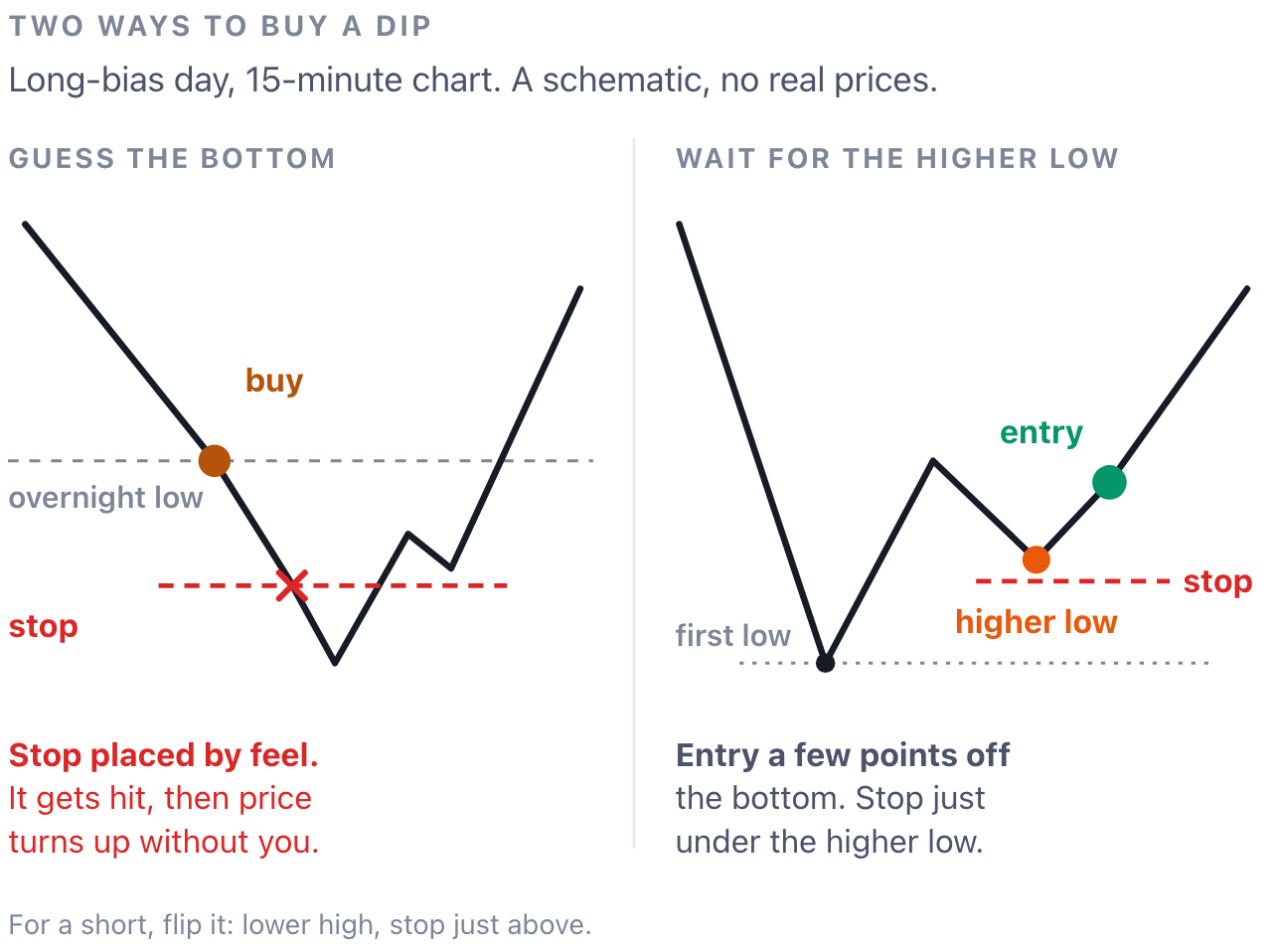
The alternative is buying the drop at the overnight low. The left side of the chart shows how that usually ends.
New posts land on Substack first. Free, one a week. The $20k test has a scoreboard, updated every Sunday.
Subscribe on SubstackWhat a higher low is
A higher low is the market showing you that buyers have stepped in. On the 15-minute chart it happens in three moves.
- Price falls and makes a low.
- It bounces.
- It dips again, stops above the first low, and turns back up.
That second dip is the higher low. Sellers had a chance to push price to a new low and couldn't. When price turns up from there, I enter.
For a short it's the mirror image. Price rallies to a high, pulls back, rallies again but stalls below the first high, then turns down. That's a lower high, and the stop goes just above it.
I would rather pay a few points to see the buyers than guess the bottom for free.
A few points for a stop with a home
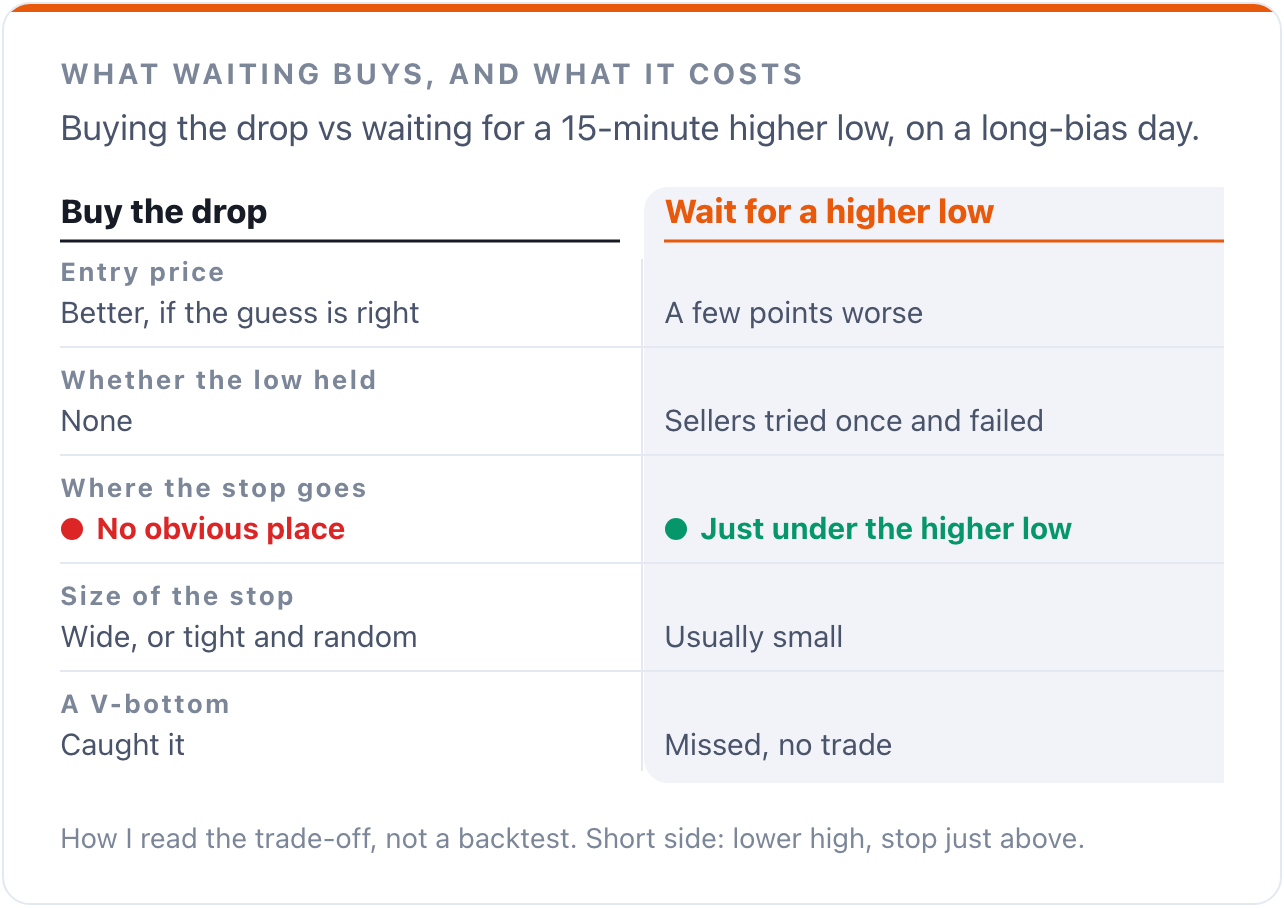
The cost is real. By the time a higher low forms and turns up, price is already off the bottom, and whoever bought the exact low got a better price. Some days no higher low forms at all. Price bottoms in a V and rips straight up, and I'm not in. I let it go.
What I get back matters more to me. If the higher low breaks, the idea is wrong, so the stop goes just under it. Nothing about it is placed by feel.
That stop is also small, because the higher low usually sits close to where I enter. A small stop keeps a loss small and lets me size the trade properly.
This is the third step on the sticky note in My strategy fits on a sticky note, and one of the checks my setup indicator runs (My indicator breaks even. I gave it $2,400 and 60 days to get better.).
That's the whole method. A note, two lines on the chart, and one 15-minute candle. The expensive part is the account underneath it, so the next series reads the prop firms' rulebooks one at a time.
Next: A prop account isn't one thing
New posts land on Substack first. Free, one a week. The $20k test has a scoreboard, updated every Sunday.
Subscribe on Substack