Every day you don't tilt is a good day
Two mornings with the same two losing trades, and why only the tilted one hurts the account.
There's one line in my trading notes I come back to: "Remember, every single day as long as you don't go on tilt, you've made progress against your goals."
Tilt is what happens when a loss takes the wheel. You stop trading the plan and start trading to get the money back.
Two mornings, same first two trades. They're an illustration, not real trades, but every number in them follows my rules: 5 MNQ, a 20-point stop, $200 a loss.
New posts land on Substack first. Free, one a week. The $20k test has a scoreboard, updated every Sunday.
Subscribe on SubstackSame start, two endings
The first setup shows up around 9:45. It meets your rules, so you take it, with entry, stop and target decided before you click. It stops out. Down $200.
A second setup comes a few minutes later. Also by the rules, also a loser. Down $400, and it's 10:10.
From here the two mornings split.
In the first, you stop. Down $400 stings, and you can feel the urge to win it back. Treat that urge as the signal to close the platform. Write two lines in the journal and go make coffee. The account is fine, the loss is well inside a $1,000 daily max, and tomorrow you sit down with the same plan and the same size.
In the second, you tilt. A third trade with no setup, just a feeling that it has to bounce. Double size, 10 MNQ, to win the $400 back in one shot. It stops out for another $400. Then a fourth at 20 MNQ, four times the 5 MNQ max, and when price gets close to the stop you move it from 20 points to 25. That's 20 × 25 × $2, another $1,000.
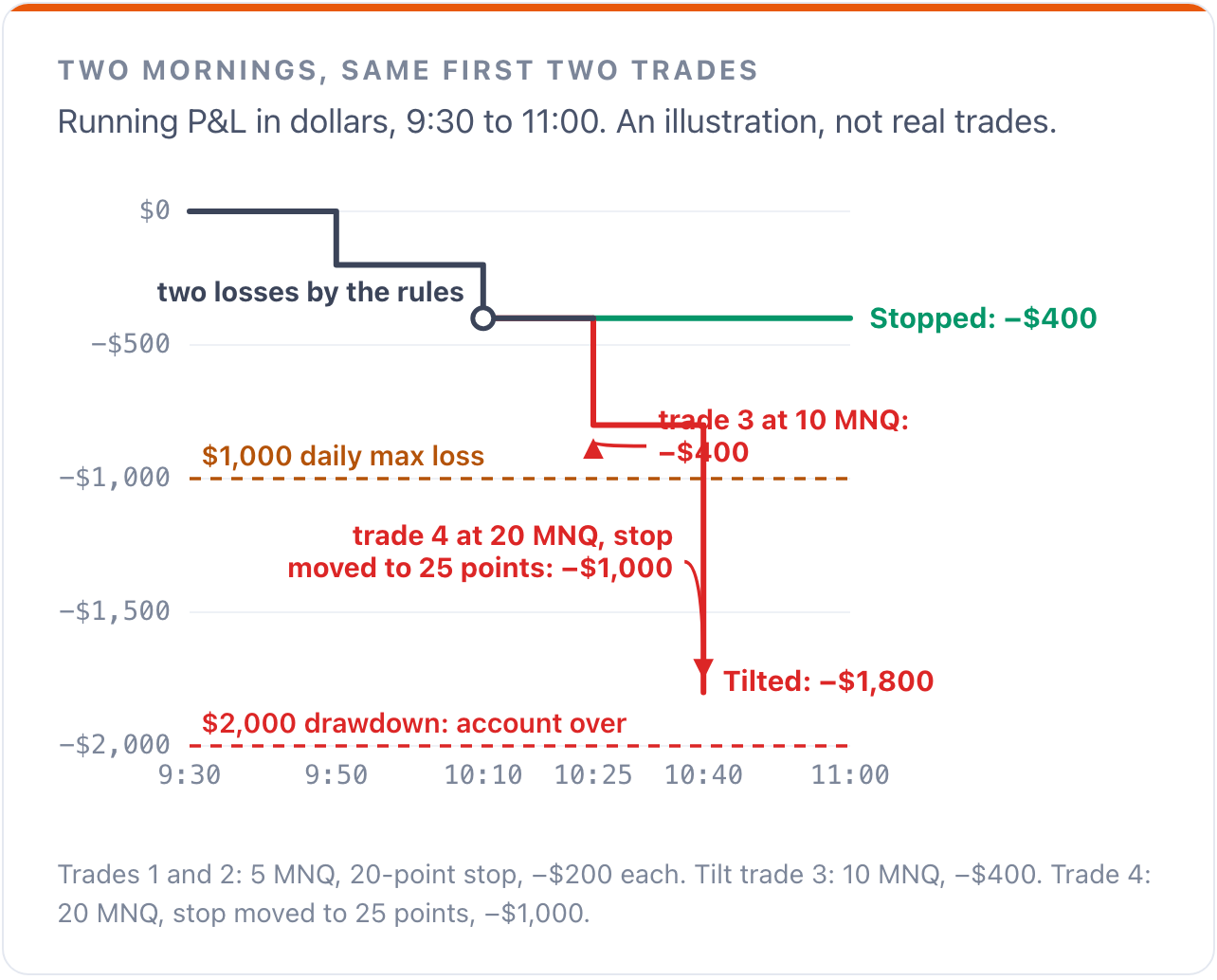
By 10:40 the tilted morning is down $1,800. It broke the daily max on the way down. Prop accounts have a trailing drawdown, a floor that follows your account up and ends it if you touch it. With a $2,000 trailing drawdown, there's $200 left before the account is gone.
Ten good days, one bad hour
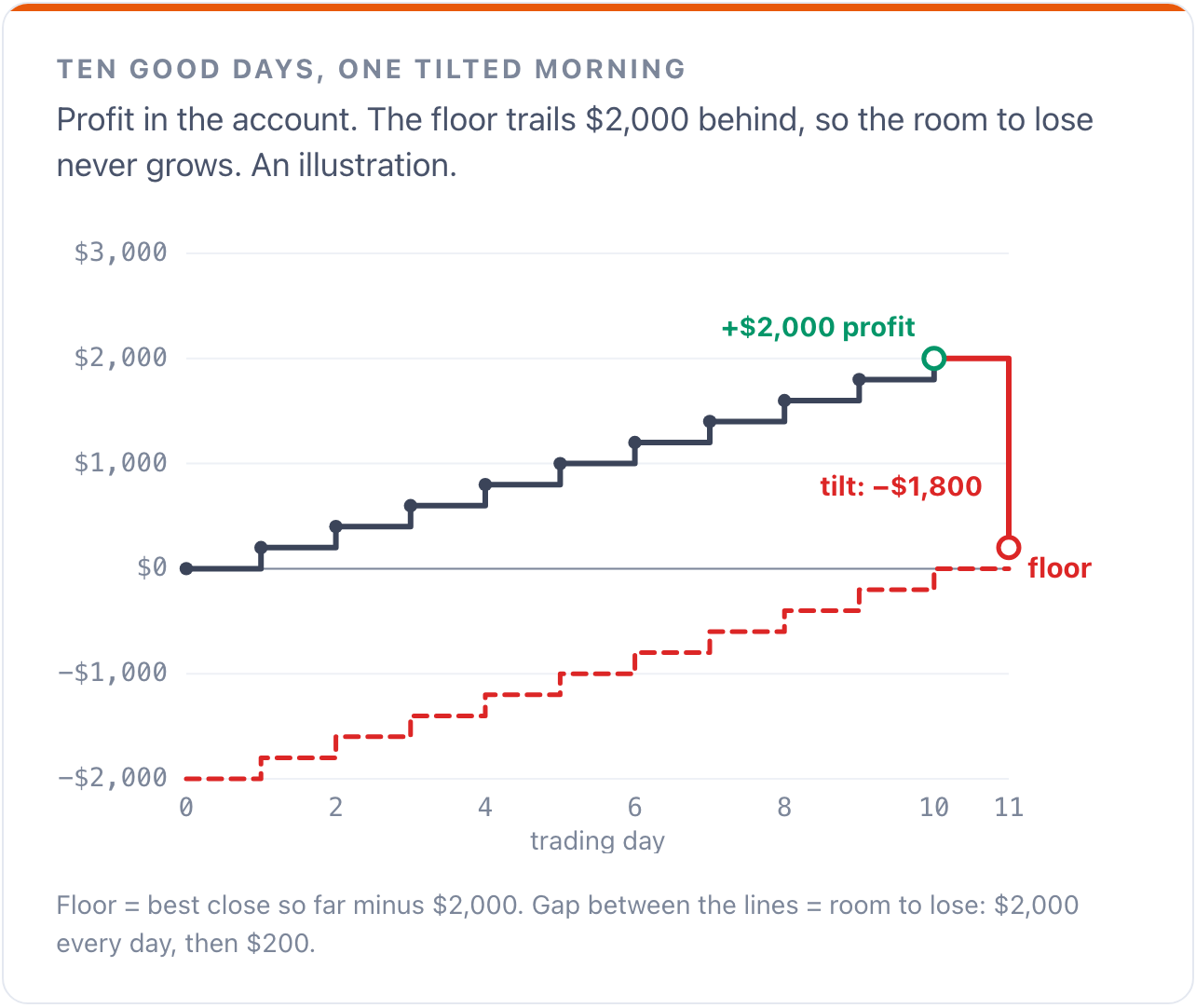
Prop accounts make tilt worse, because the floor follows you up. Ten $200 days put the account $2,000 in profit, but the floor has climbed behind every one, so the room to lose is still $2,000. One tilted morning takes $1,800 of it.
Red by the rules still counts
A red day traded by the rules is the cost of running the plan. Every plan has losing trades. If the rules have an edge, the losers are already counted in, and taking them is part of the work, the same as taking the winners.
A tilt day isn't part of any plan. The trades have no setup, they're bigger than they should be, and they come exactly when you're thinking least clearly.
My tilt rules
- The $1,000 daily max is set before the open. When I hit it, I'm done for the day, even if the next candle looks perfect.
- I never size up after a loss. If I want to, that's the signal to stop, not to click.
- I grade the day on whether I followed the rules, not on whether it was green.
Next: Was it a trade or was it a move?
New posts land on Substack first. Free, one a week. The $20k test has a scoreboard, updated every Sunday.
Subscribe on Substack