Was it a trade or was it a move?
Price goes somewhere every day. A trade is only the part that matched my plan.
Missing a 100-point move in NQ costs exactly $0. The account is the same size after the move as it was before. The money it feels like you lost was in a trade that never existed.
Chasing that move is where the money actually goes. So after every big candle, I ask myself one question. Was it a trade, or was it a move?
New posts land on Substack first. Free, one a week. The $20k test has a scoreboard, updated every Sunday.
Subscribe on SubstackA trade is planned before 9:30, a move just happens
A trade is something I planned. It met my rules, in the direction I wrote down before 9:00, at a level I marked before the open. I knew my entry, my stop (the price where I'm wrong and get out) and my target before I clicked. If it shows up and I take it, that's a trade, win or lose.
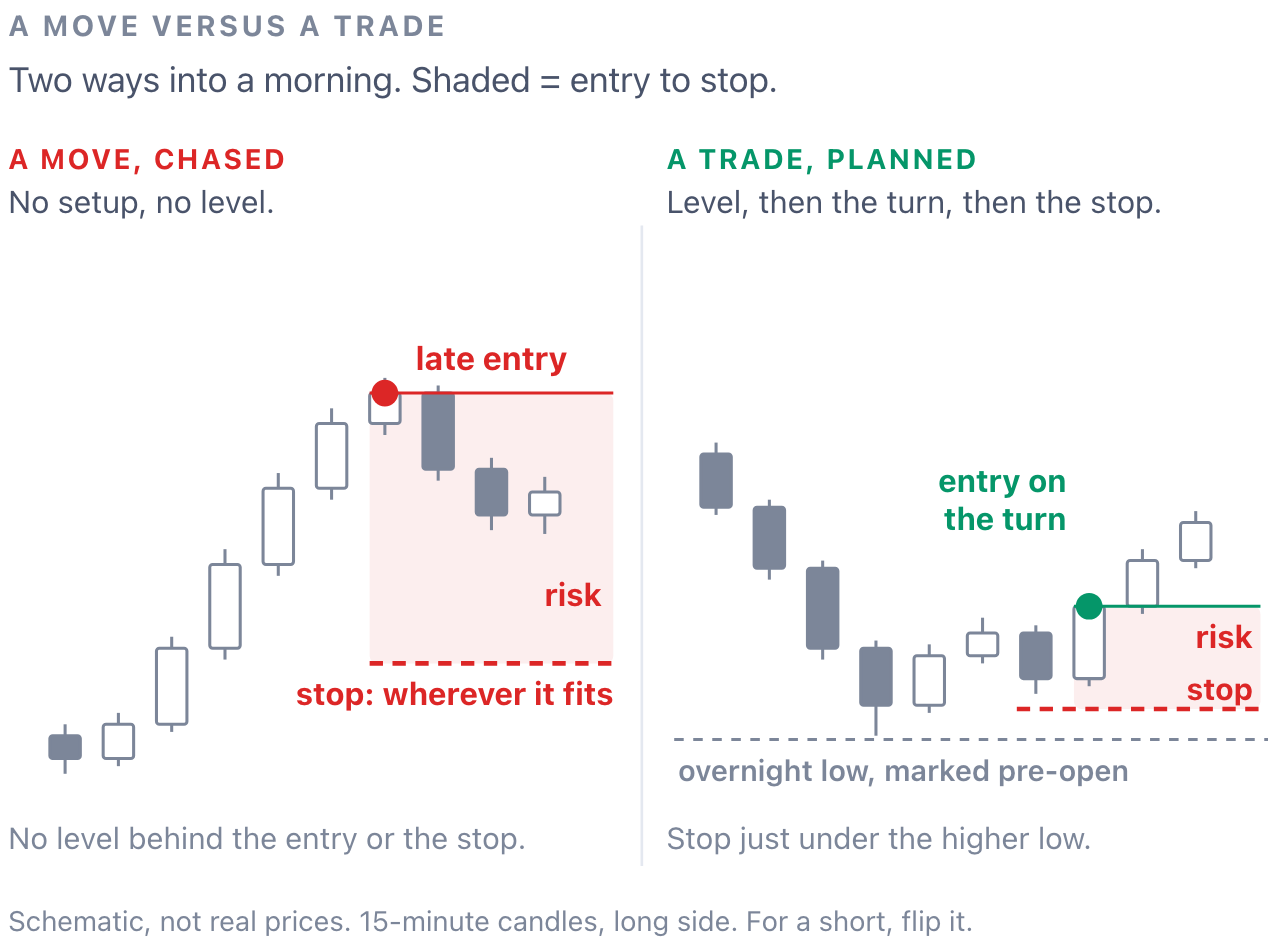
A move is price going somewhere. It happens every day, in both directions, often with no setup anywhere near it. Chasing a move is a guess, made late, at about the worst price of the morning.
Chasing costs more than missing
A chase goes wrong in three places.
- The entry is far from any level that made sense, because the move already happened.
- The stop has no home. It's either huge, so one loss eats a big piece of the day, or tight and random, so normal noise takes you out.
- You're buying from the traders who got in early and are happy to take profit on you.
Even a chase that works is a bad trade. It teaches you that breaking the plan pays, and that lesson costs more later than a small loss costs now.
There's a second cost. The setup I actually planned might come at 10:20. If I spent my focus, or part of my $1,000 daily max, on a chase, I'm not ready for the trade I came for.
The check after a big candle
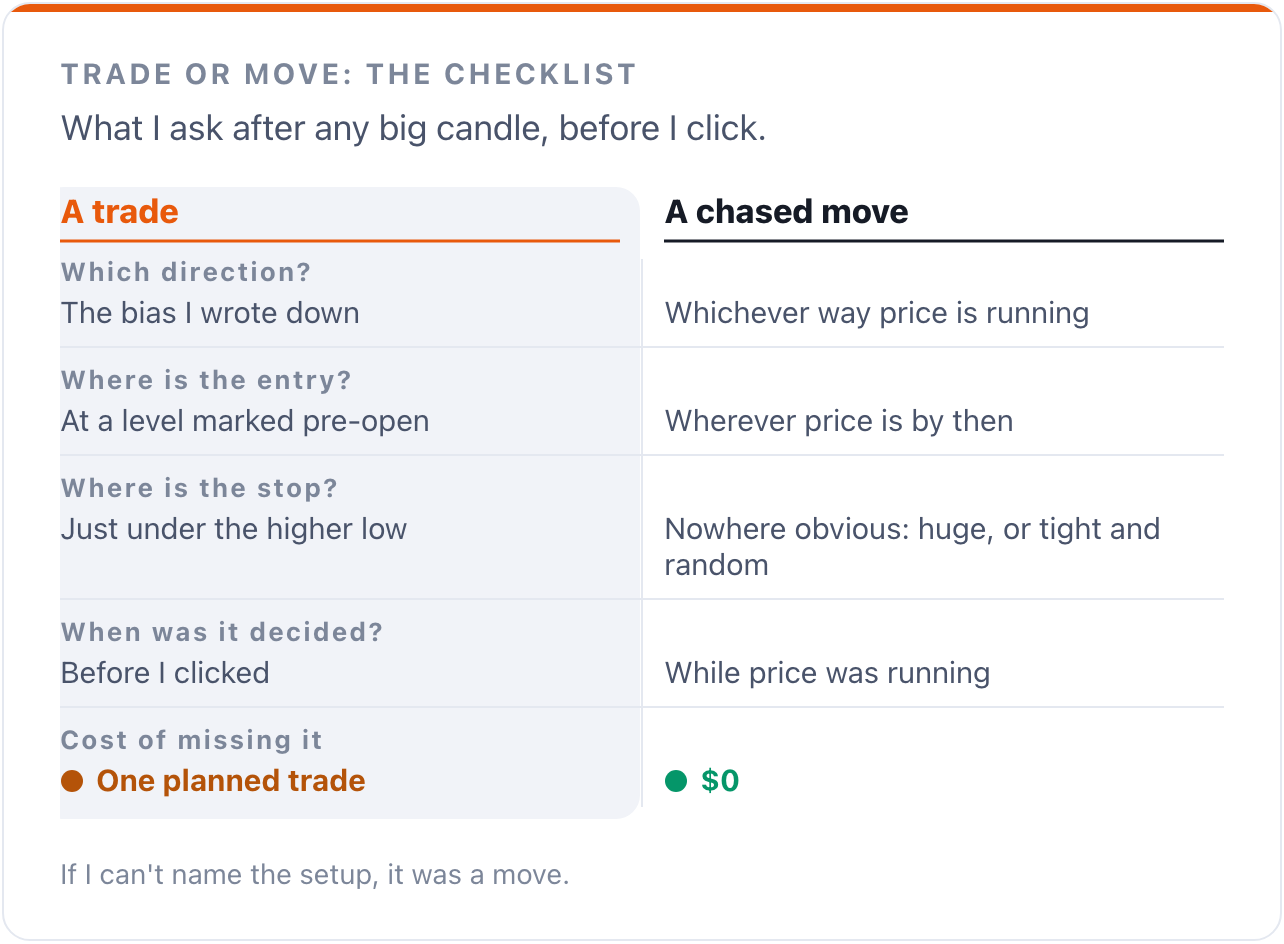
After a big candle I go through four steps.
- Ask the question. If I can't name the setup, it was a move.
- Don't count missed moves as losses. My journal is for trades I took, not moves I watched.
- If I still want in, wait for the setup to form again: a pullback to a level and a 15-minute higher low (or lower high) in my direction. Sometimes it does. Often it doesn't.
- Check the chart against the plan I wrote before the open. Don't rewrite the plan to fit the chart.
The plan is written before 9:30 for exactly this moment. When price is running, I'm the worst person to be deciding what the plan should be.
Next: $500 a day is a lot of money
New posts land on Substack first. Free, one a week. The $20k test has a scoreboard, updated every Sunday.
Subscribe on Substack