I coded a YouTube trader's setup. Zero of 64 versions made money.
A setup you can say in four steps is a rule, and a rule can be backtested. The first run looked great because the fills were wrong.
In the last post, 134 of one host's 389 replayed trades matched the setup he teaches. A third of a method isn't a method, but it is the part he can say out loud, and anything that can be said out loud can be coded. So in September 2026 I coded it.
The setup, as he describes it:
- Wait for a strong 5-minute candle in the direction of the move.
- Let price pull back about halfway into it.
- Rest a limit order there (an order that only fills at your price or better).
- Put the stop just beyond the candle's wick.
He adds a few house rules: first target at one times the risk, or scale out in thirds; trade the New York morning only; two trades a day, stop after two losses. I coded those too.
New posts land on Substack first. Free, one a week. The $20k test has a scoreboard, updated every Sunday.
Subscribe on SubstackThe first backtest paid me inside one minute
Seven years of MNQ 1-minute bars, May 2019 to September 2026, one micro contract, $1.74 a round turn in costs. The first run showed a worst losing stretch of about $400 in seven years. A setup that never loses $400 doesn't exist, so I checked the fills before I checked anything else.
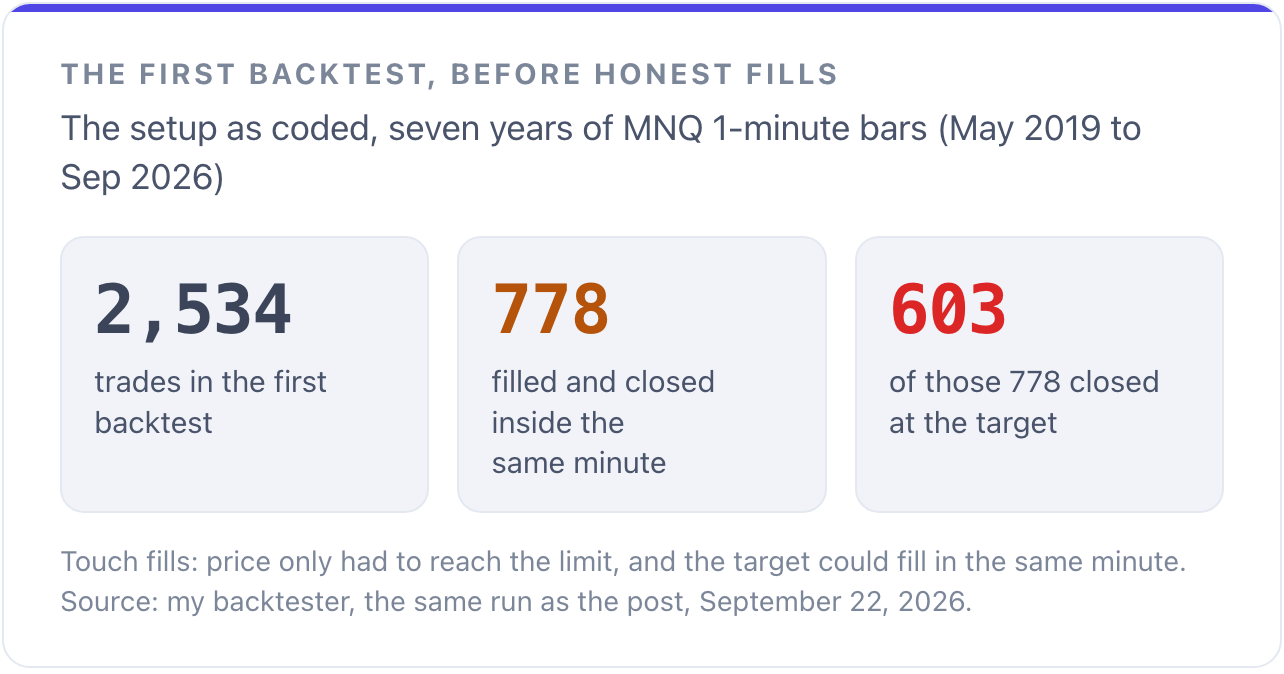
A 1-minute bar has a high and a low and no order between them. The backtester saw the low touch my limit and the high touch my target in the same bar and assumed both went my way. In real life, price touching your limit often means you didn't get filled at all, and if you did, you don't get to pick which came first.
Take those 778 trades out and the rest won 52% and made $24. Over seven years.
Honest fills, 64 versions
Two rules fixed it. Price has to trade through my limit, not touch it. And no target on the bar that filled me.
Then I ran 64 versions of the setup, all written down before the run: the pullback at 50% or 61.8%, with or without the volume rule, with or without a VWAP-side filter, one target or thirds, two candle-size floors, with or without a 15-minute trend filter.
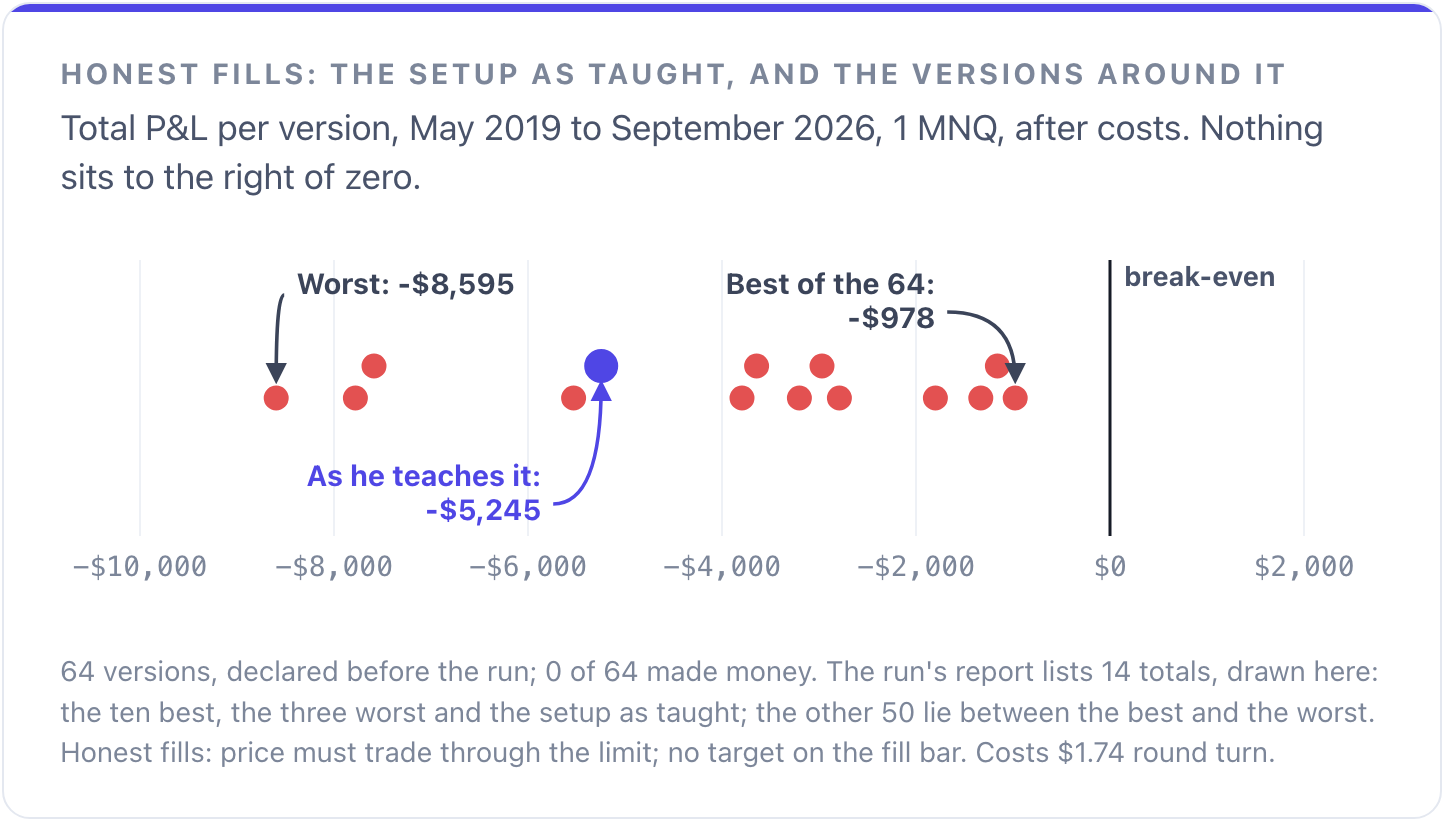
The best version lost $978 on 2,642 trades, a 51% win rate with wins and losses about the same size. The setup exactly as taught lost $5,245 on 2,456 trades. Winning half of one-to-one trades, after costs, is a slow loss.
The luck test
Run 64 versions and pick the best, and you will find something that looks good by luck. So I split the seven years into blocks, trained on some and tested on the rest, in every combination, and read the out-of-sample paths. Out of sample, the average path lost money. And the test that asks "how likely is it that your best version only looks best by luck" came back at 40%. I don't trust anything above 20%. Fail on both counts.
A bot can only copy what can be said out loud
A bot can only copy the part of a method a trader can say out loud.
The part he could describe was the easy part to copy, and it had no edge. If he has one, it lives in the other two thirds of his trades: which level, which day, when to sit out. That doesn't show up in a transcript, so it can't show up in code.
Four checks I run now before I copy anyone:
- Check their trades against the price data, not their recap.
- Split the method into rules they can write down and calls they make in the moment. Only the rules go in a bot.
- Give every limit-order backtest honest fills: price trades through my price, and no target on the bar that filled me.
- When a backtest looks too good, check how it filled before checking how much it made.
That settled what a bot could trade. The next question was where it was allowed to.
Next: The firm with the API isn't the firm that allows the bot
New posts land on Substack first. Free, one a week. The $20k test has a scoreboard, updated every Sunday.
Subscribe on Substack