The firm with the API isn't the firm that allows the bot
Topstep has the clean API, Lucid has the permission, and getting both onto one account takes a workaround.
The YouTube study closed on September 22, 2026, with 0 of 64 versions making money, and the same day my own bot sent its first click-to-execute signals on a Topstep evaluation account. From then on the rules around the account mattered as much as the code.
When I started building that bot, I picked Topstep for one reason: it has a real API.
An API is a door for software. Instead of clicking buy and sell on a screen, your own program sends the order. Topstep's platform, TopstepX, runs on ProjectX, and ProjectX publishes one: log in with a key, read prices, place orders, check positions. I built my bot's order code against it.
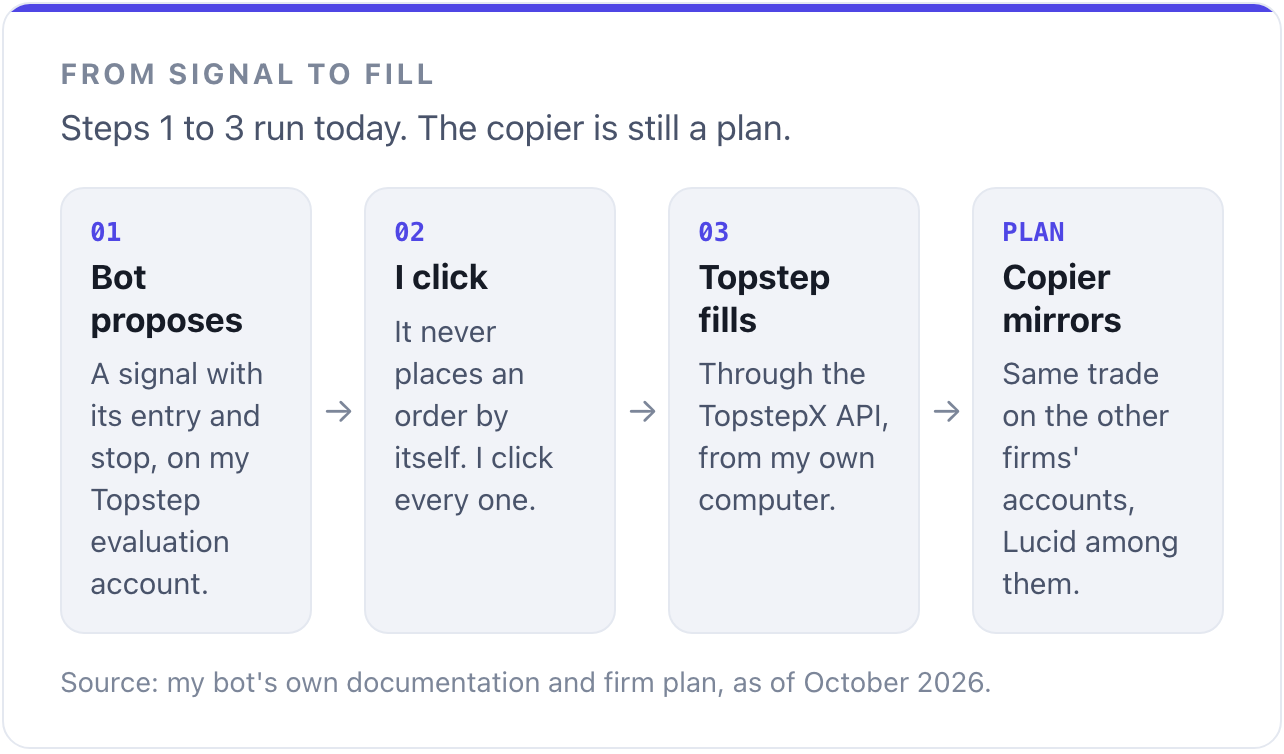
Today the bot sends click-to-execute signals on a live Topstep evaluation account, the Trading Combine. It never places an order by itself. I click every one.
Then I read the rules around that API, and the rules at Lucid, the firm that says yes to bots.
New posts land on Substack first. Free, one a week. The $20k test has a scoreboard, updated every Sunday.
Subscribe on SubstackTwo firms, side by side
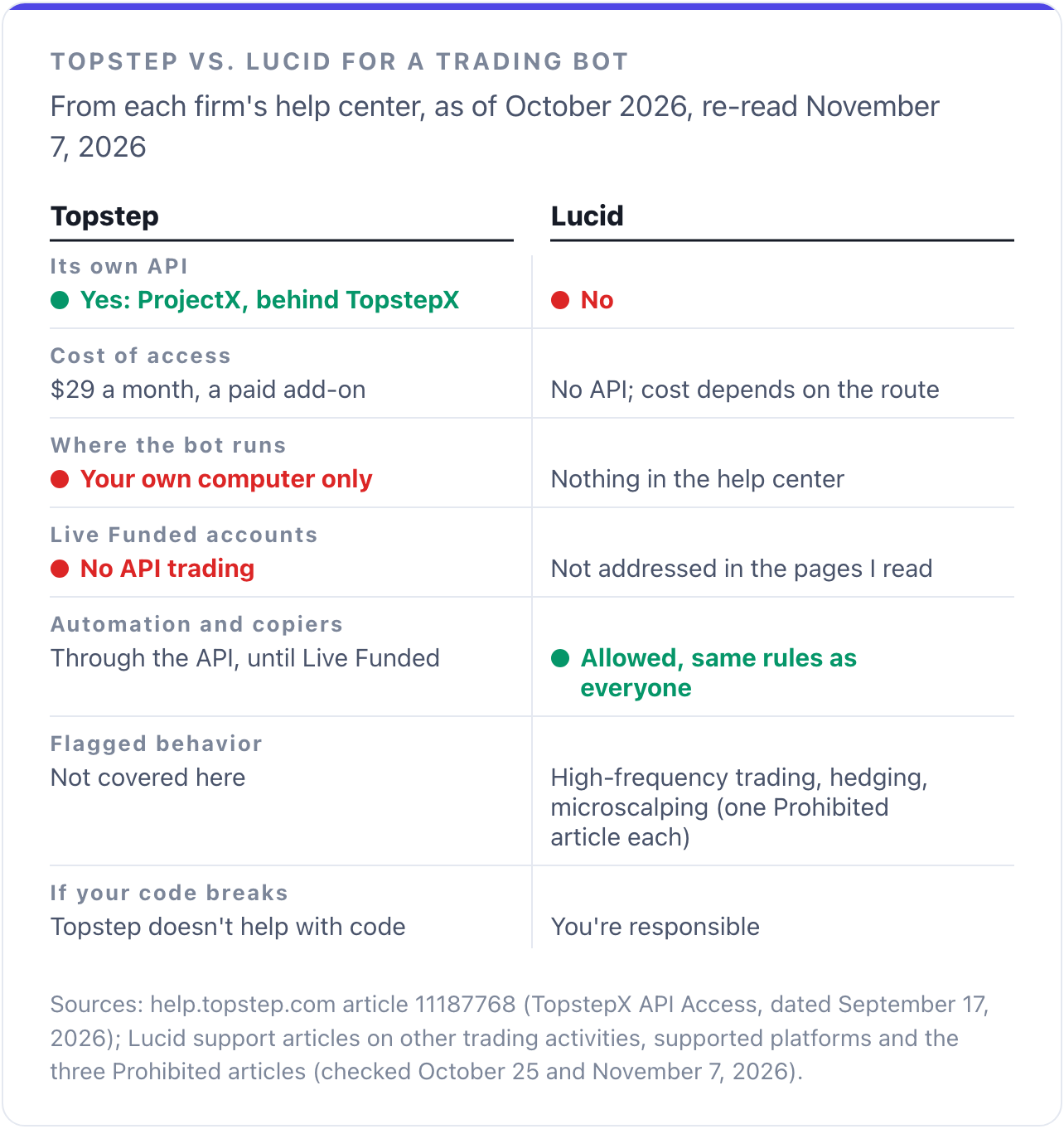
Topstep's own line: "your server can watch and record, but it cannot trade." Your own computer only. Access is a paid add-on, $29 a month on Topstep's API page.
The API also stops at Live Funded. Topstep's wording is that one key covers "every eligible account under your profile," and that live funded accounts can't trade through it. So it covers the accounts before Live Funded, on a laptop that has to be awake at 9:30. Get moved to a Live Funded account, and API trading ends.
Lucid is the opposite. Its rules allow automated systems and trade copiers, and there is nothing in its help center about having to run from your own device. But it doesn't publish an API. You trade it through platforms that connect over two data networks, CQG and Rithmic: NinjaTrader, Tradovate, TradingView, Quantower, Sierra Chart and others.
Three ways onto a Lucid account
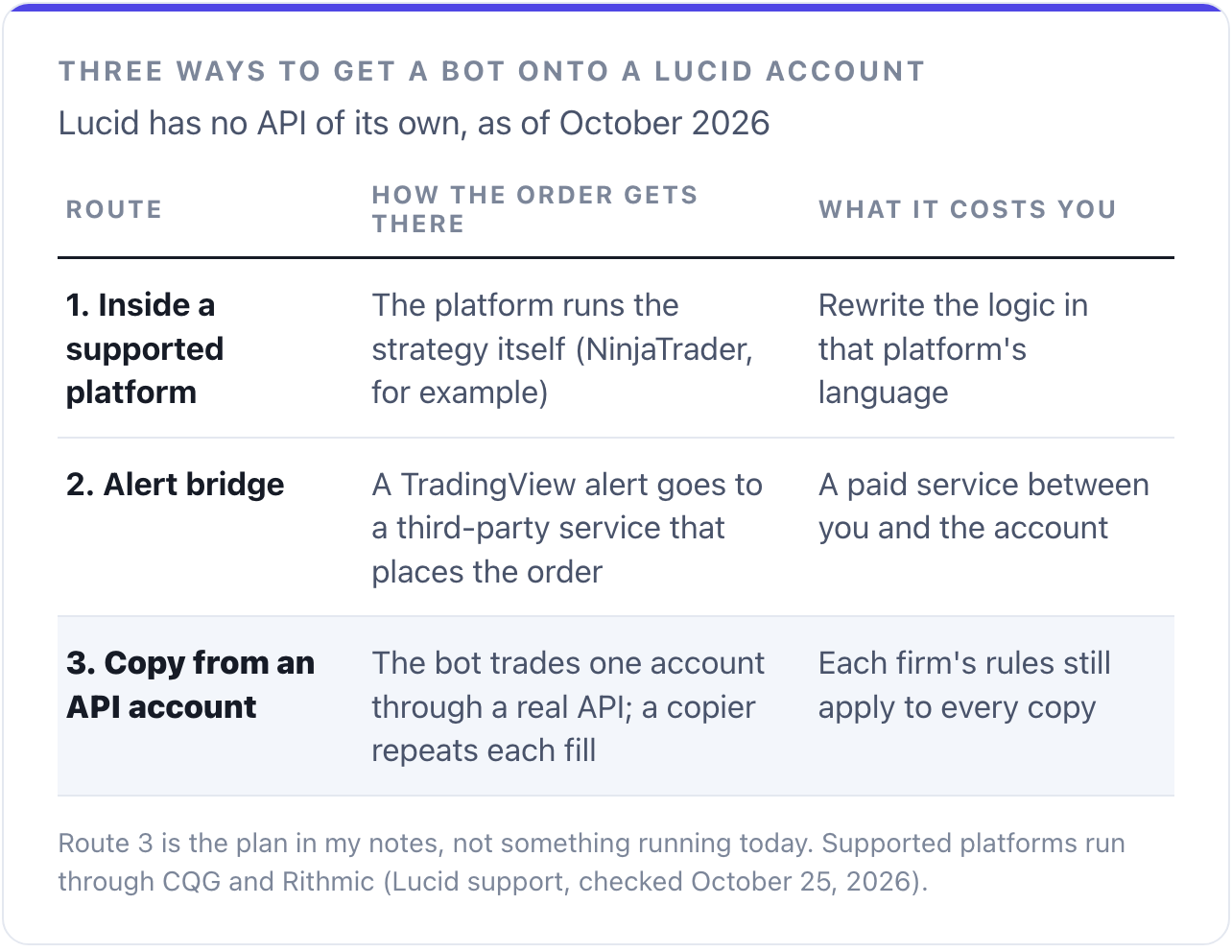
My notes point at the third. Topstep is the master, because that's where my bot's API connection and its test simulator are already built. A copier would then mirror each fill onto the other firms' accounts, Lucid among them.
That's a plan. It isn't running.
A copier copies the mistakes too
Each firm's rules still apply to every copy. Lucid's Flex drawdown follows your end-of-day balance; some firms track it during the day. Lucid flags hedging and microscalping (most of your profit from trades held five seconds or less). And Lucid says you're responsible if the software breaks.
The way I wrote it in my notes: a copier multiplies mistakes at the same speed as profits.
The rules the bot lives under
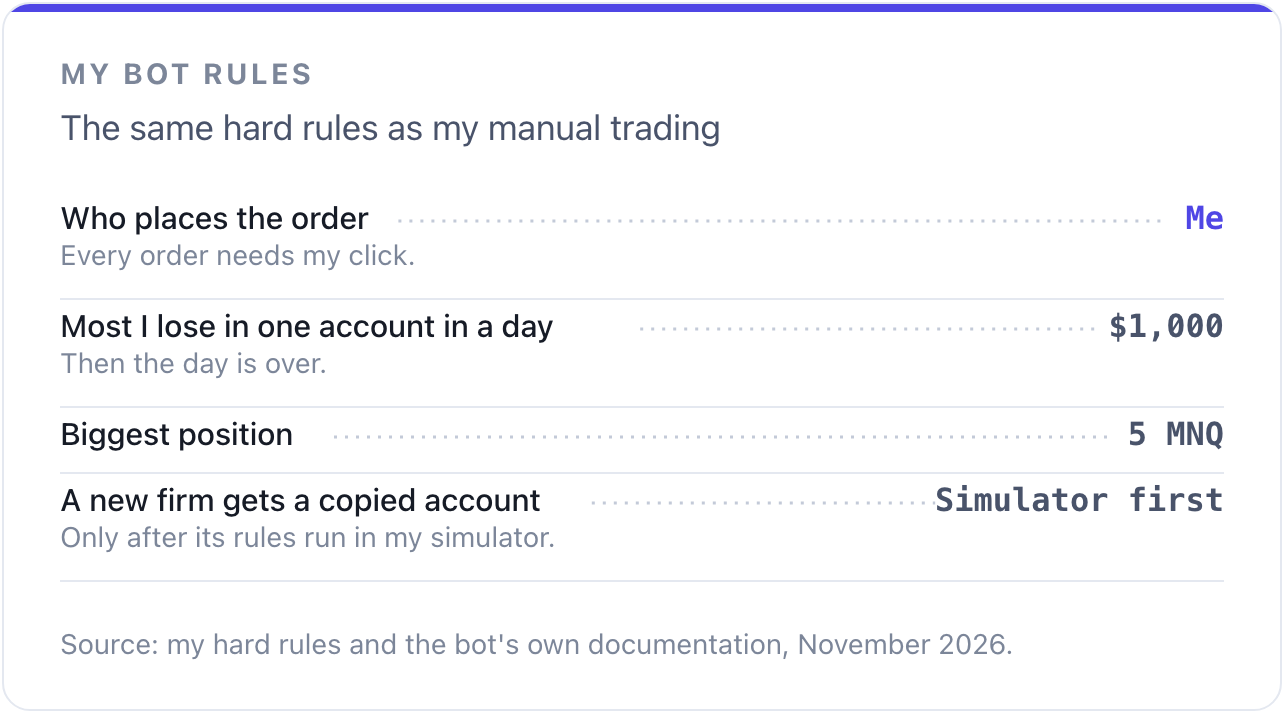
At a $1,000 daily cap, it takes two full losing days to burn through a $2,000 loss limit like the one on a $50,000 LucidFlex account. A copier would put every account on the same two days at once, which is why each firm's rules go through the simulator before it gets a copy.
So the bot has a door at Topstep and a permission at Lucid. What it doesn't have is an edge I'd hand my own setup to: the taught setup failed every version, and my setup, run as fixed rules, breaks even. Fixing that is what the next 60 days are for.
Next: My indicator breaks even. I gave it $2,400 and 60 days to get better.
New posts land on Substack first. Free, one a week. The $20k test has a scoreboard, updated every Sunday.
Subscribe on Substack