I checked 1,465 live trade calls against the tape. 5 in 6 were honest.
Two YouTube channels, nine regular hosts who call their entries on air (plus the odd guest), 1,052 streams. I turned the talk into a table and lined it up with 1-minute prices.
Live-trading YouTube is the one place you can watch a trader call an entry before it plays out. There is no recap after the close and no screenshot to trust. He says he's in at 9:47, and the trade plays out on camera.
I wanted that in a table. Two live-trading channels, nine traders who call their entries on air, about 1,050 archived streams between them. If their methods have rules in them, the rules should show up in the data. If they don't, that shows up too.
This was the summer and autumn of 2026, alongside the bot I was building, and it changed what I asked the bot to do.
New posts land on Substack first. Free, one a week. The $20k test has a scoreboard, updated every Sunday.
Subscribe on SubstackFrom a livestream to a row
Five steps. Download the audio of every archived stream. Turn the speech into text. Have an AI model read each transcript with a strict brief: a trade counts only when the host says he is in or filled, on his own account, at that moment. Add the transcript offset to the stream's start time to get a clock time. Then replay the trade on 1-minute bars from the stated entry to the stated exit.
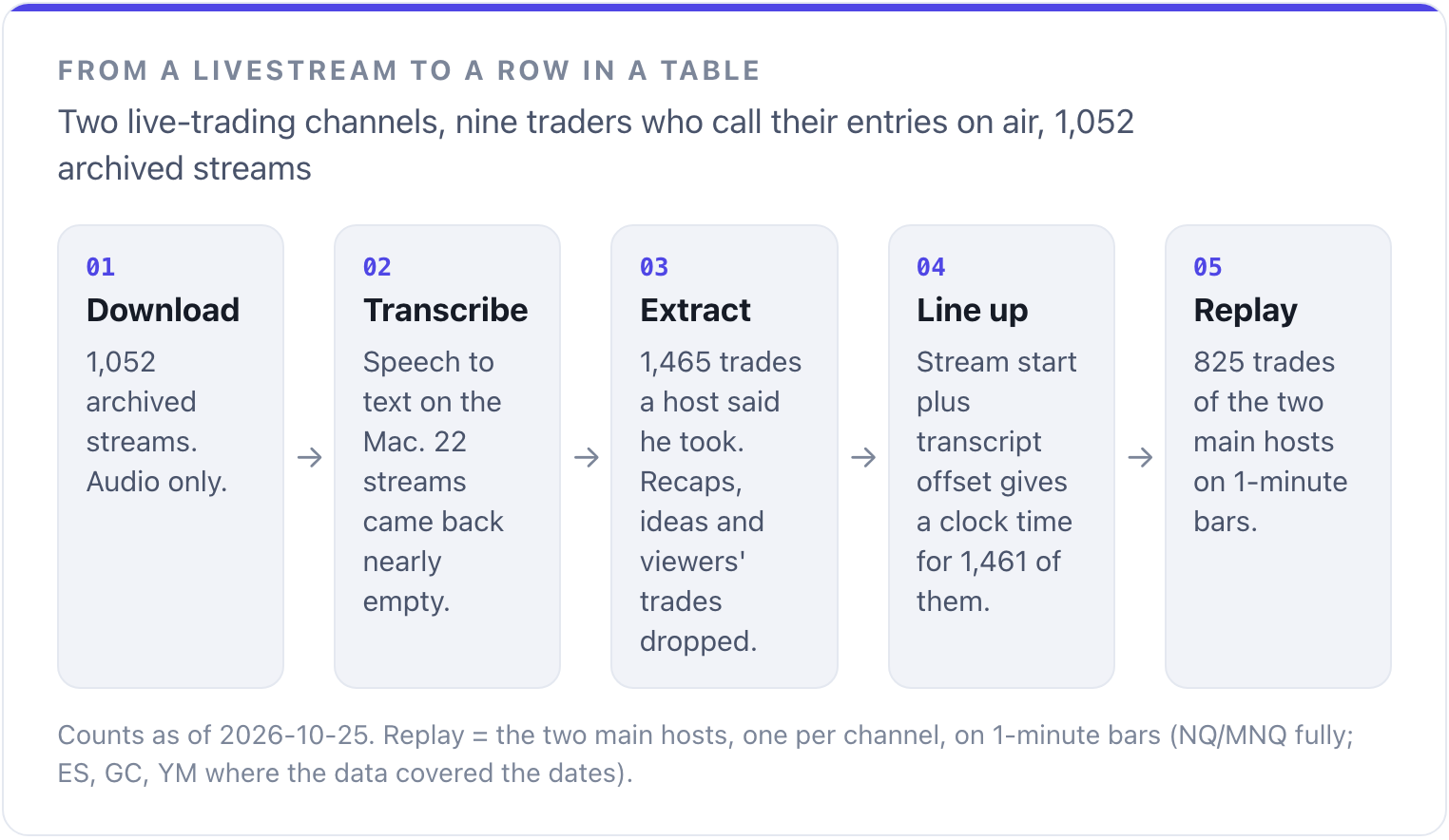
About one stream in four had no trade at all: a teaching day, a no-trade day, a stream that was mostly chat.
What breaks
Every step had a failure mode, and most of the work was catching them.
- The speech-to-text model loops. When the host goes quiet, it fills the silence by repeating one phrase, sometimes for minutes. 22 streams came back nearly empty, and a repeated phrase inside a good transcript had to count as nothing.
- Recaps aren't trades. A host describing this morning's trade at 2 pm is not a fill at 2 pm. The session notes flag a recap in 231 of the 1,052 streams, and six edited recap videos were dropped whole so their trades weren't counted twice.
- Viewers' trades. Hosts read the chat aloud, entries included. 108 streams mention them. None count.
- Results that were never said. 130 of the 1,465 trades ended with no clear stated outcome. A numeric stop was said on 486 trades (33%) and an entry price on 391 (27%). The rest had to come from the tape.
- Prices as spoken. Traders say the last three digits. The replay snaps the spoken price to the nearest print at that minute, and where no price was said it uses the bar close.
When the calls happen
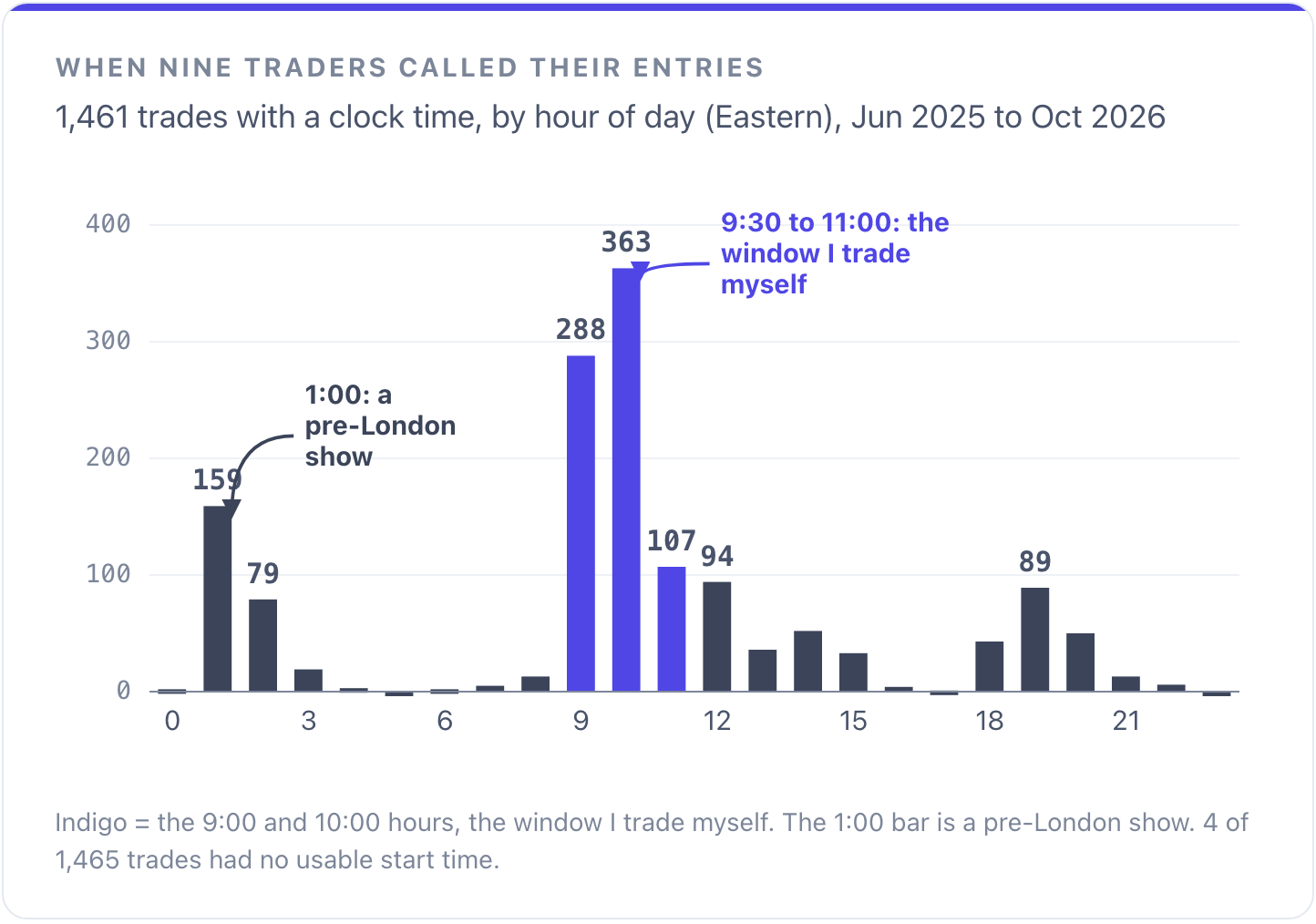
758 of the 1,461 timed trades fell in the 9, 10 and 11 o'clock hours. That is my window too, which is partly why these channels were the ones I watched.
What the tape says
Two hosts, one per channel, had enough tagged trades to replay: 825 trades on 1-minute bars.
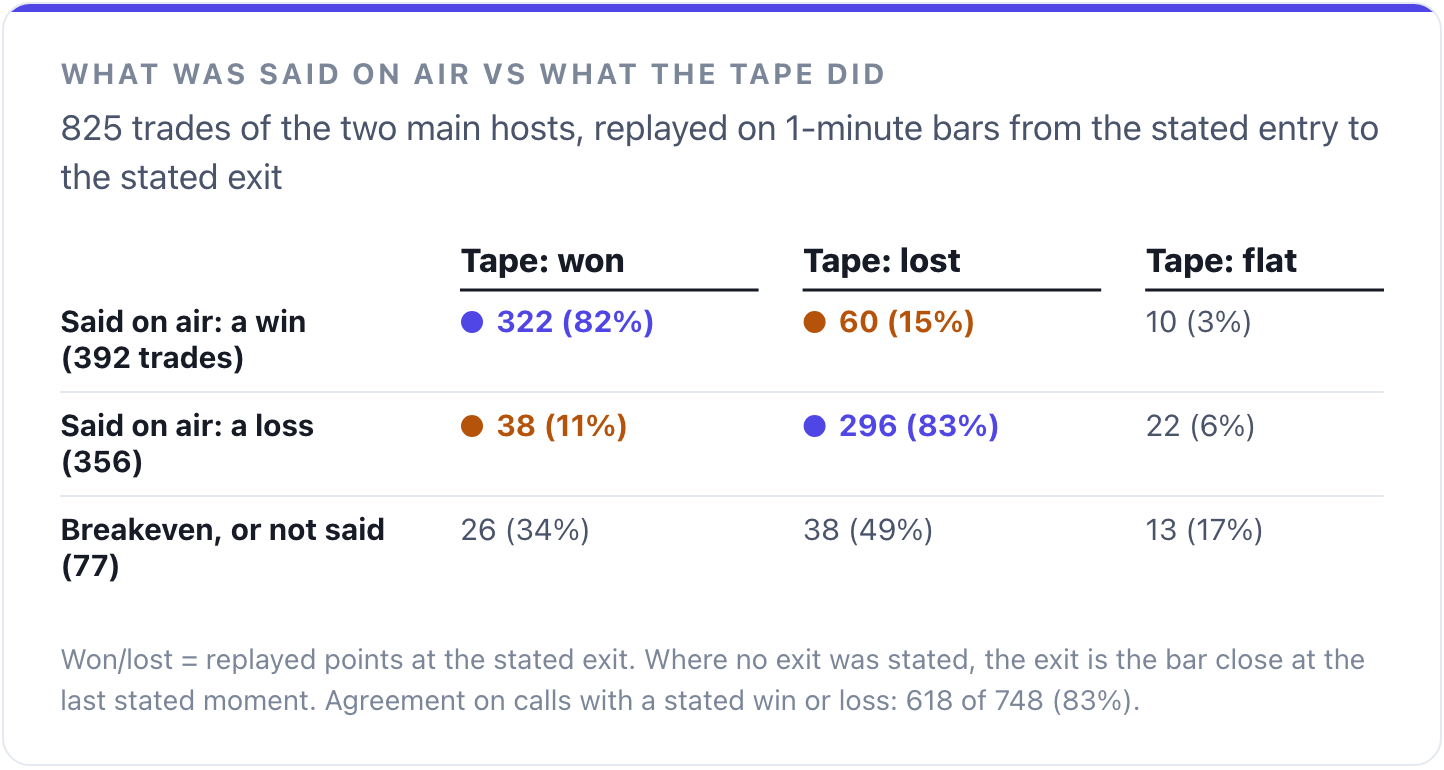
Five in six is better than I expected and worse than a scorecard. 60 called wins were losses on the tape; 38 called losses were wins. The two errors nearly cancel, so the overall rate is about honest even when a single call isn't.
Across the 825, the tape has them winning 47% of trades and losing 48%, with the rest flat. Average result +2.9 points per trade, median zero. Winners were held a median 9 minutes, losers 4. On air, across all the calls with a stated result, 59% were called wins. That's a different sample from the 825 replayed, so I won't put the two numbers side by side; the replayed set is the one I trust.
A rule or a call?
One host teaches a single setup and describes it the same way every few streams: a strong 5-minute candle in the direction of the move, a limit order about halfway back into it, the stop beyond the candle's wick. That is a rule, so I coded the description and checked the chart at each of his 389 replayed entries.
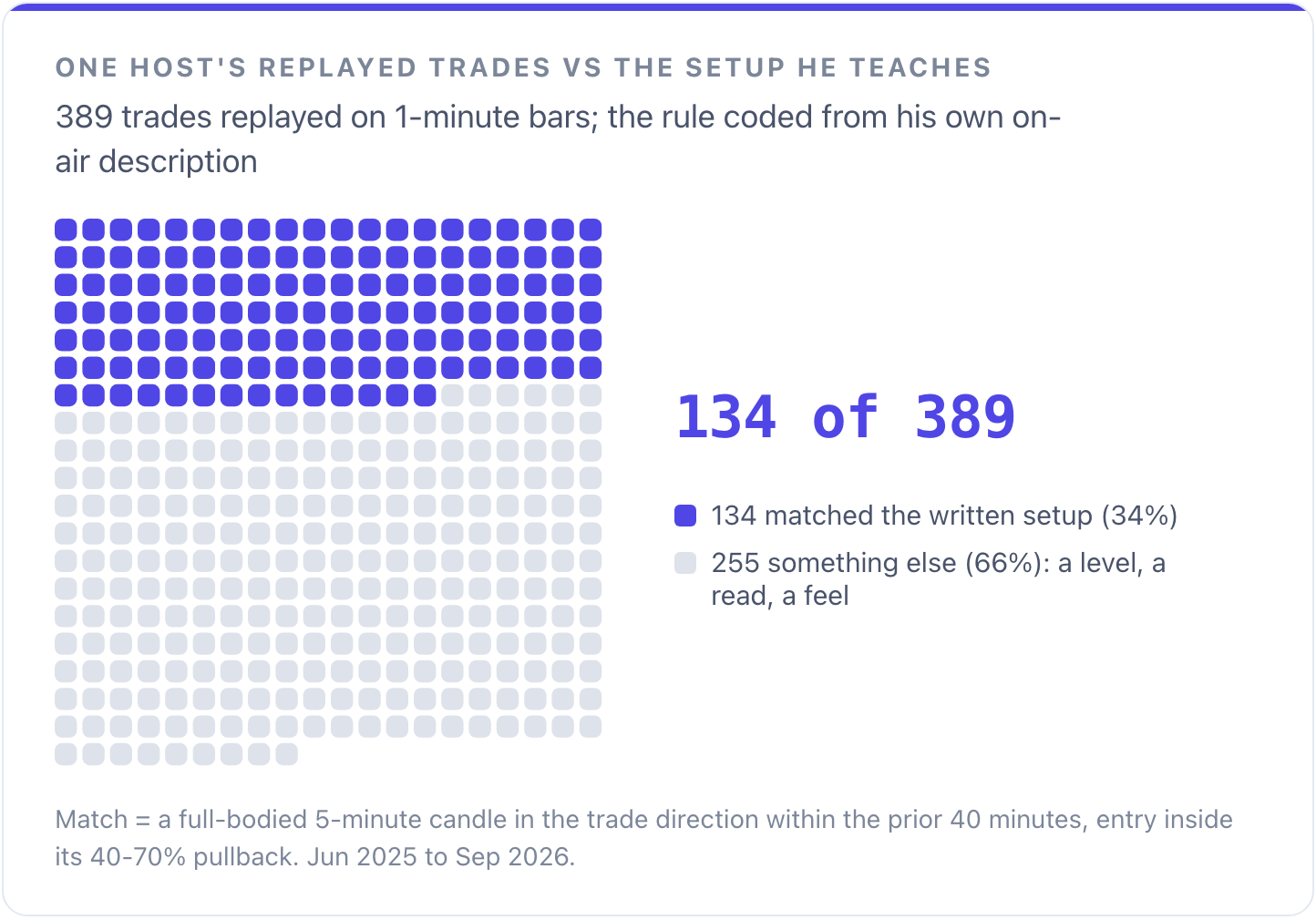
Two thirds of a method with a written rule is not the rule. The written third is the part you can hand to a machine. The rest lives in which level, which day, and when to sit out, and none of that is in a transcript.
So I handed the written third to a machine.
Next: I coded a YouTube trader's setup. Zero of 64 versions made money.
New posts land on Substack first. Free, one a week. The $20k test has a scoreboard, updated every Sunday.
Subscribe on Substack