My indicator breaks even. I gave it $2,400 and 60 days to get better.
A prop payout, a trading journal an AI can read, and a scoreboard I wrote down before I started.
MyFundedFutures paid me in early November. The account made $3,000. My cut, at an 80% split, was $2,400.
I moved it into a separate bank account, by itself. It has one job, which is paying for my funded accounts from here on. I'll spend less than $2,000 of it on them. If I get to $2,000, the experiment is over and I write about why.
The experiment is whether a feedback loop can make my setup indicator better.
The indicator isn't the bot. The bot sends morning-breakout signals on a Topstep evaluation, and I click every order. The indicator flags the A+ setups I trade by hand on TradingView.
New posts land on Substack first. Free, one a week. The $20k test has a scoreboard, updated every Sunday.
Subscribe on SubstackFive checks before it says A+
I built a TradingView indicator that runs my process on the 15-minute chart. Before it calls a long A+, five things have to be true. Shorts are the mirror.
- Bias. The 4-hour and daily chart both say long. If they disagree, no trade.
- Level. Price pulled back to a level I care about: the overnight high or low, an hourly level, the 9:30 opening price, or a level from my weekend prep.
- Higher low. The pullback held above the last 15-minute swing low.
- Right side of the open. The pullback bar closed above the 9:30 opening price.
- Tight stop. One tick under the pullback bar, small enough to fit my risk.
Then the next 15-minute bar has to break the pullback bar's high. That's the only trigger. My hard rules are built in: $1,000 max loss per day and 5 MNQ max. (That was v1.2. The version on the chart today adds a sixth check; The loop: one 15-minute bar in, one indicator change out has it.)
Five years of backtests: break-even
I ran it as fixed rules on the five years of 15-minute MNQ bars I have, August 2021 to July 2026. It took 236 strict A+ trades. Half won. The average trade made just under zero, and a little less after costs. The rules alone break even.
That backtest takes setups from 9:30 to 15:45 and holds each one to the target, the stop or 16:00. Only 8 of the 236 triggered by 11:00, when I log off. So it's a test of the rules across the whole day, not a test of my morning.
Then I tried to fix it. I tested five other exits, a filter for which days to sit out, and more than 100 conditions, from VIX, gold and oil to news days. Some looked great on the first half of the data and fell apart on the second. When I checked how many would look that good by luck alone, none survived.
One thing looked different. I had an AI grade each setup from the chart, the way I would. Its A+ picks averaged about +0.19R from 2021 to 2023 and +0.13R since (R = what I risk on the trade). That's only 95 trades, too few to call it real. It's a hint that the rules find the setups and the judgment on top might be the edge.
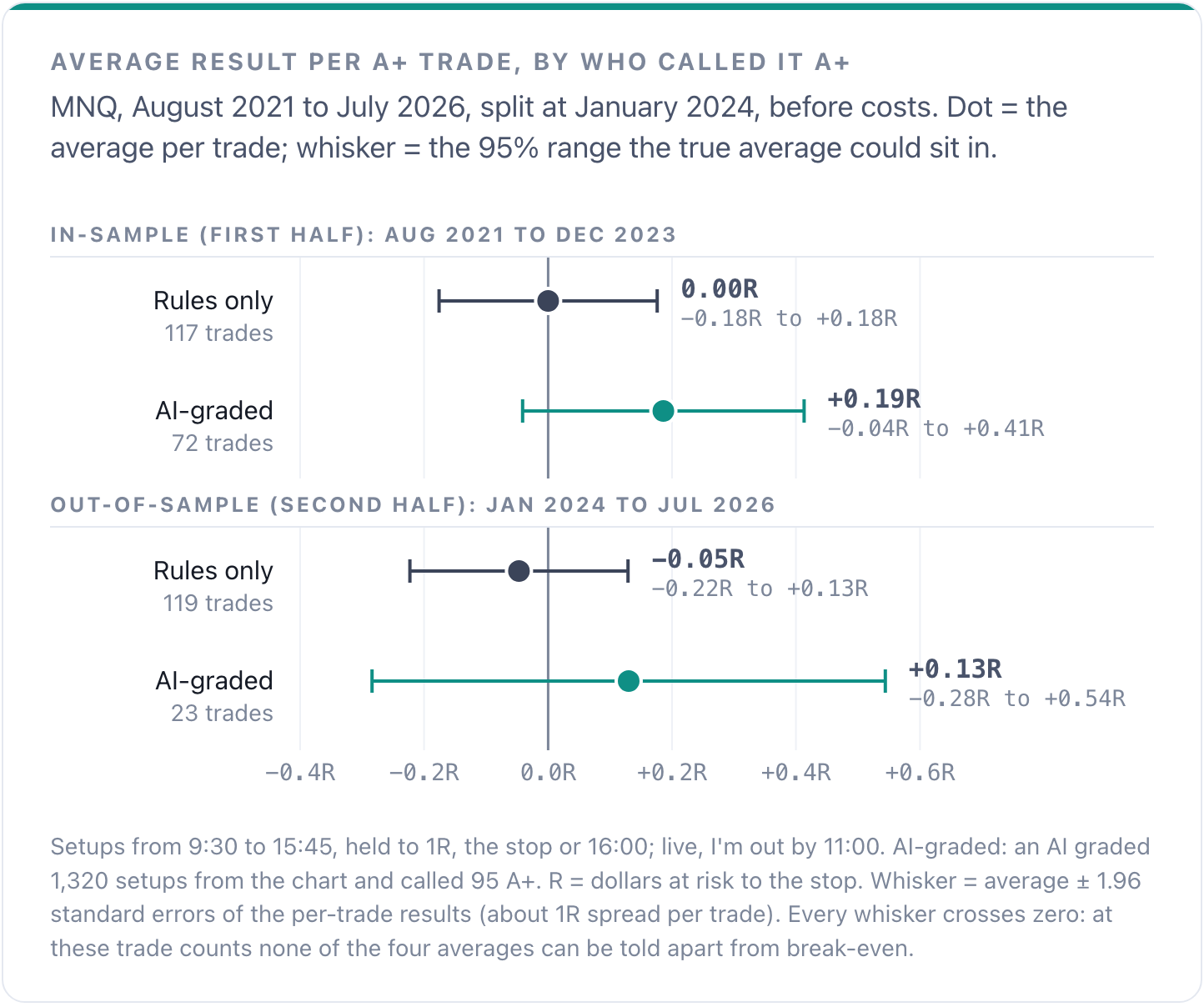
Fixed rules break even. So I change one thing at a time and test it on trades it hasn't seen.
The account it's traded on
The test runs on MyFundedFutures Pro 50K evaluations, bought with the payout. The firm's numbers, as of November 7, 2026: an evaluation costs $159 on promo, $265 at the regular price. The target is $3,000. The max loss is $2,000, trailing, checked at the end of each day, and there is no daily loss limit. A 50% consistency rule applies in the eval only. Payouts open 14 days after the first trade, with a $2,100 buffer kept in the account, $1,000 minimum, split 80/20. The funded Pro 50K caps size at 3 micros, below my own 5 MNQ ceiling, so the firm's cap binds first.
At $265 each, less than $2,000 buys seven evaluations. At the promo price, twelve.
The loop
TradeZella, my trading journal, now has a connector (an MCP server: a plug that lets an AI tool read your journal). I hooked it up to an AI coding assistant.
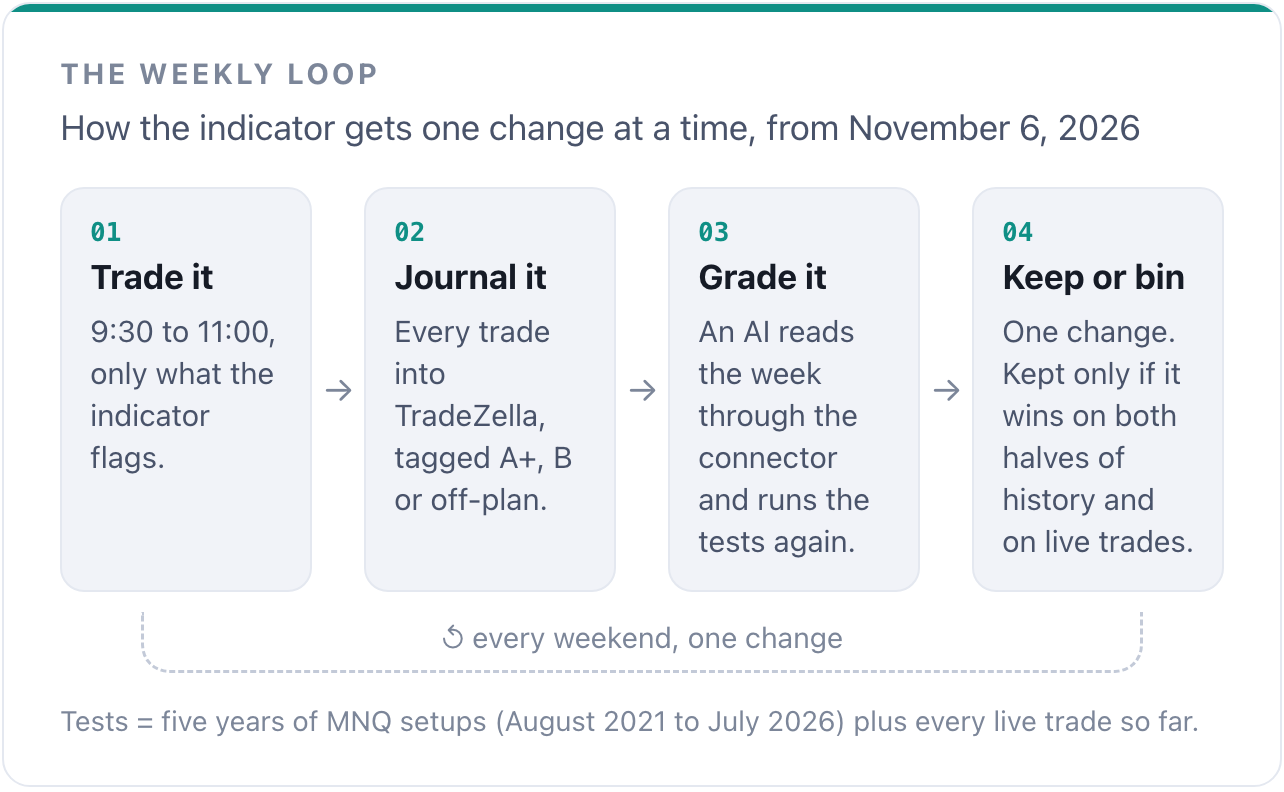
Each weekend the AI lines my trades up with what the indicator said and proposes one change. I write the test down before it runs. That's hill climbing: one step at a time, and step back if it didn't go up.
The danger is fooling myself. Try enough changes and one will look great by luck; my own tests showed that. So it's one change a week, written down first, and it has to work on trades it has never seen.
The scoreboard, written November 6, 2026
In 60 days, early January, I check four things, and I've written down what counts as a yes. The record that I wrote it first is this post's own publish date, November 6, 2026.
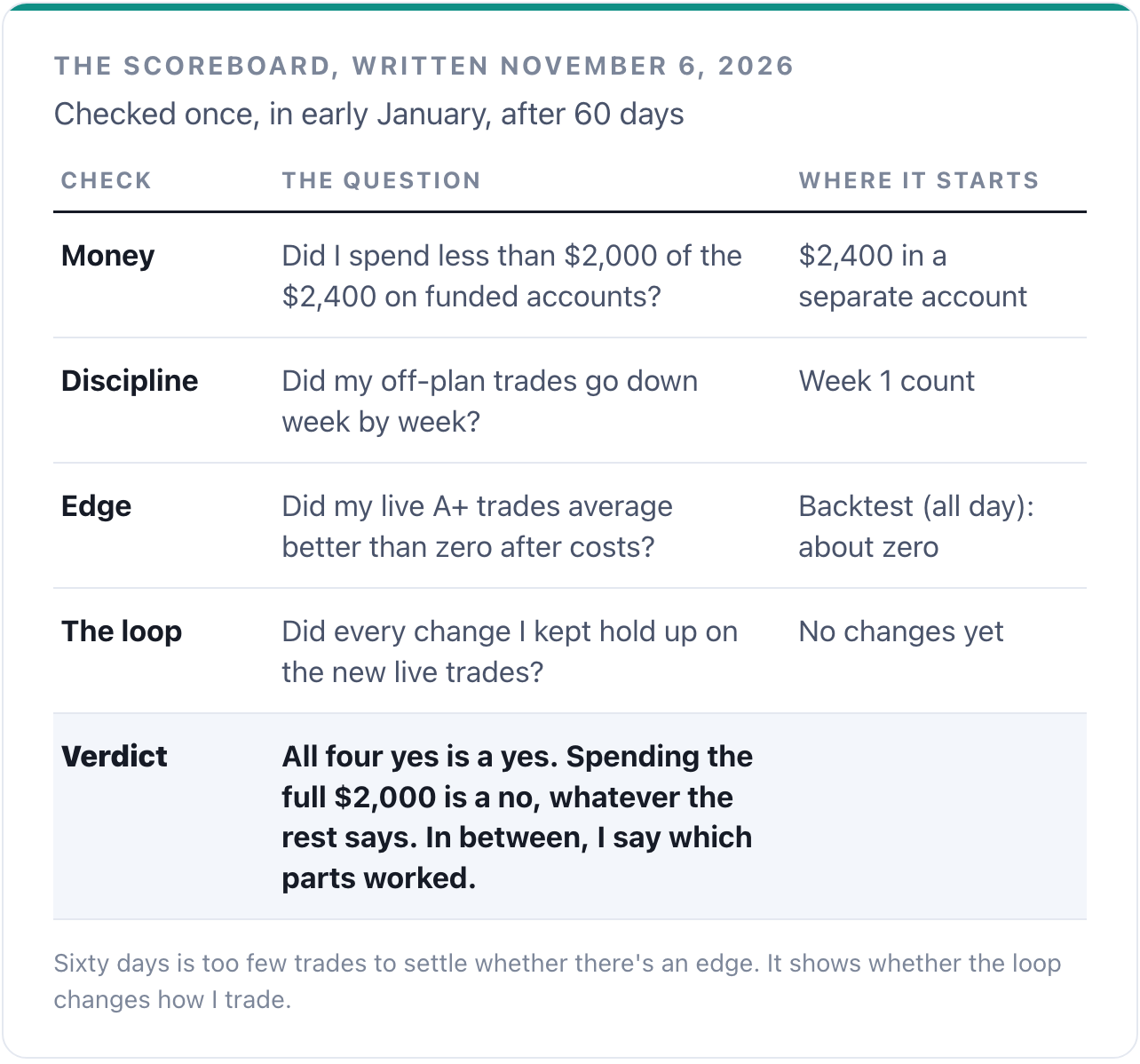
The Edge check is underpowered, and I'm saying so now: one or two A+ setups a week in the 9:30 to 11:00 window means maybe 10 to 20 trades in 60 days, far too few to settle whether the setups make money. So the primary outcome is discipline and whether the loop holds up, and whether the money is still there. Edge is secondary.
Next: The loop: one 15-minute bar in, one indicator change out
New posts land on Substack first. Free, one a week. The $20k test has a scoreboard, updated every Sunday.
Subscribe on Substack