I'm changing the test. One indicator, one instrument, two months, $20,000.
Three days into the $2,400 test I found a better starting line. Here it is, with the numbers, before the first trade.
Last weekend I went looking for why my level setups work on some days and bleed on others.
I took five years of them, written as fixed rules on MNQ, and put every trade next to one number: how far price was from yesterday's close when I got in.
Trades taken close to yesterday's close lost money. Every losing dollar over five years came from there. Trades taken once price had moved away, in either direction, made money.
So I'm changing the test. Same money, same two months, a different indicator, and a number on the wall.
The indicator
Before the open I draw three things on the chart.
- Yesterday's close. One line.
- The balance zone. A band around that line. Its width comes from the VIX, so it's wide on a wild day and narrow on a quiet one. On a normal day it's about 150 points each way on MNQ.
- The outer band. Twice as wide. When price gets out there, the day has picked a direction.
The rule is one sentence. No level trades while price is inside the zone. Outside it, long or short, the setups I already trade are allowed. Inside it, I wait.
That's it. No new entry, no new exit, no new stop. The zone decides when the old plan is allowed to run.
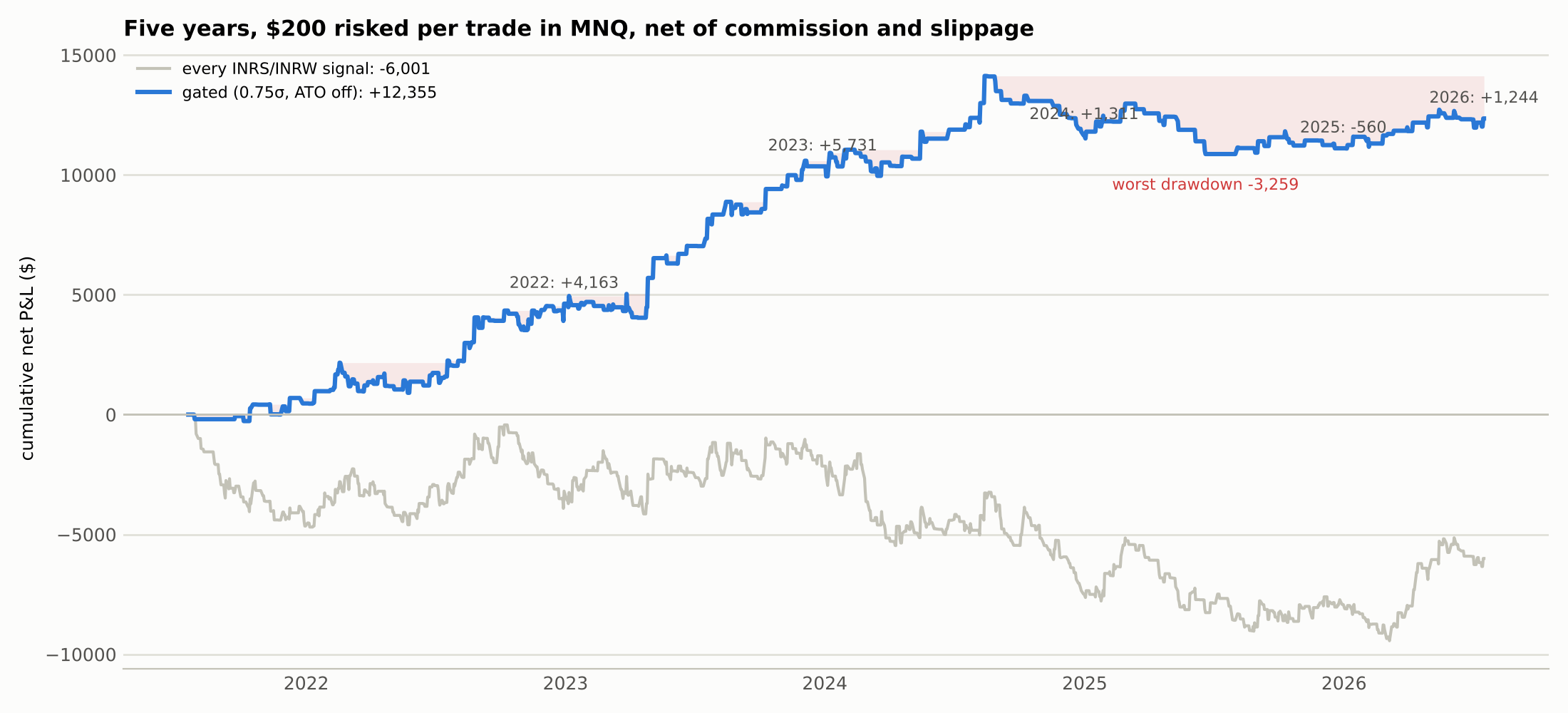 Five years of the same setups at $200 risk a trade. Gray takes every signal and ends down $6,000. Blue skips the ones inside the zone and ends up $12,000. Worst drawdown on the blue line was about $3,300.
Why it works, in plain words
Near yesterday's close the market is in balance. Price crosses the same levels back and forth and the 15-minute bar that looks like a turn isn't one. Away from yesterday's close the day has decided something. When it turns at a level out there, it means it.
What surprised me is that the direction doesn't matter much. A turn against the move at an extreme works almost as well as a turn with it. It's the middle that kills.
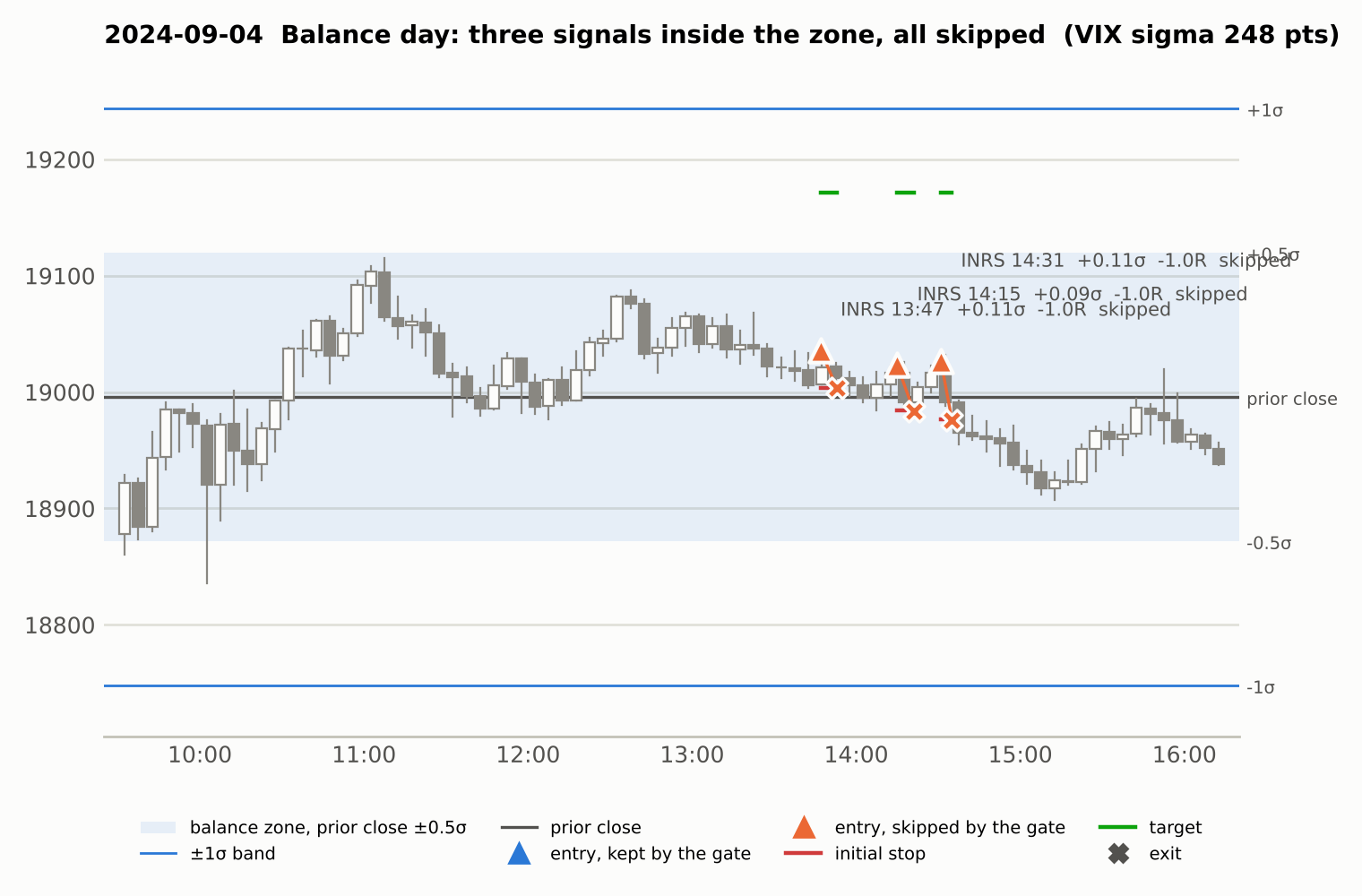 A September 2024 session. Price never left the zone. Three setups fired within 45 minutes of each other and every one stopped out. The rule skips all three.
The honest part
I found this looking backward, on the same five years I scored it on. That is exactly how traders fool themselves. So I wrote the test down before trading it, and the first real test is the months the backtest never saw.
The numbers are good for a filter: positive in every year and the same in both halves of the data. They are not proof. Two months live is where proof starts.
One more honest thing. Most of these setups fire between 10:30 and 3:30, and I've traded until 11:00 for years. So for the test, the window gets wider. The plan allows entries until 3:30 and is flat by 4:10, and that is the window now. Two hours was a habit, not a rule. If the wider window costs me at work, that goes in the readout too.
The test
- One indicator. The zone rule above, version 1, drawn every morning.
- One instrument. MNQ.
- Two months. November 9, 2026 to the close on Friday, January 8, 2027.
- One number. $20,000 of profit on prop accounts by the end.
The money is the same $2,400 payout, in its own account. Less than $2,000 of it buys evaluations at about $150 each. The hard rules don't move: $1,000 max loss per account per day, 5 MNQ per trade, no entries after 3:30, flat by 4:10.
$20,000 in forty trading days is $500 a day. I wrote a post about how much that is. The backtest says the rule makes money, not that it makes $500 a day on one small account, so getting there means passing evaluations early and running the same signals on more than one funded account.
If I get to $20,000, you'll see every trade. If I don't, you'll see the number I did get to, and what I'd change.
What I do now
- Draw yesterday's close, the zone and the band before every open.
- Take my level setups only outside the zone. Inside it, I sit.
- Log every trade with the distance from yesterday's close, so the journal can check me.
- Read out the numbers every Sunday: trades, wins, dollars, and how far from $20,000 I am.
See it on real charts: The zone on the chart: nine pictures of the rule.
Next: Thirteen trades won't tell me if it works. Following the rules will.
New posts land on Substack first. Free, one a week. The $20k test has a scoreboard, updated every Sunday.
Subscribe on Substack