The $100 line that changes everything
How one end-of-day close freezes Tradeify's trailing floor, and what that does to a funded account's value.
One close at +$2,100 changes a Tradeify funded account for the rest of its life.
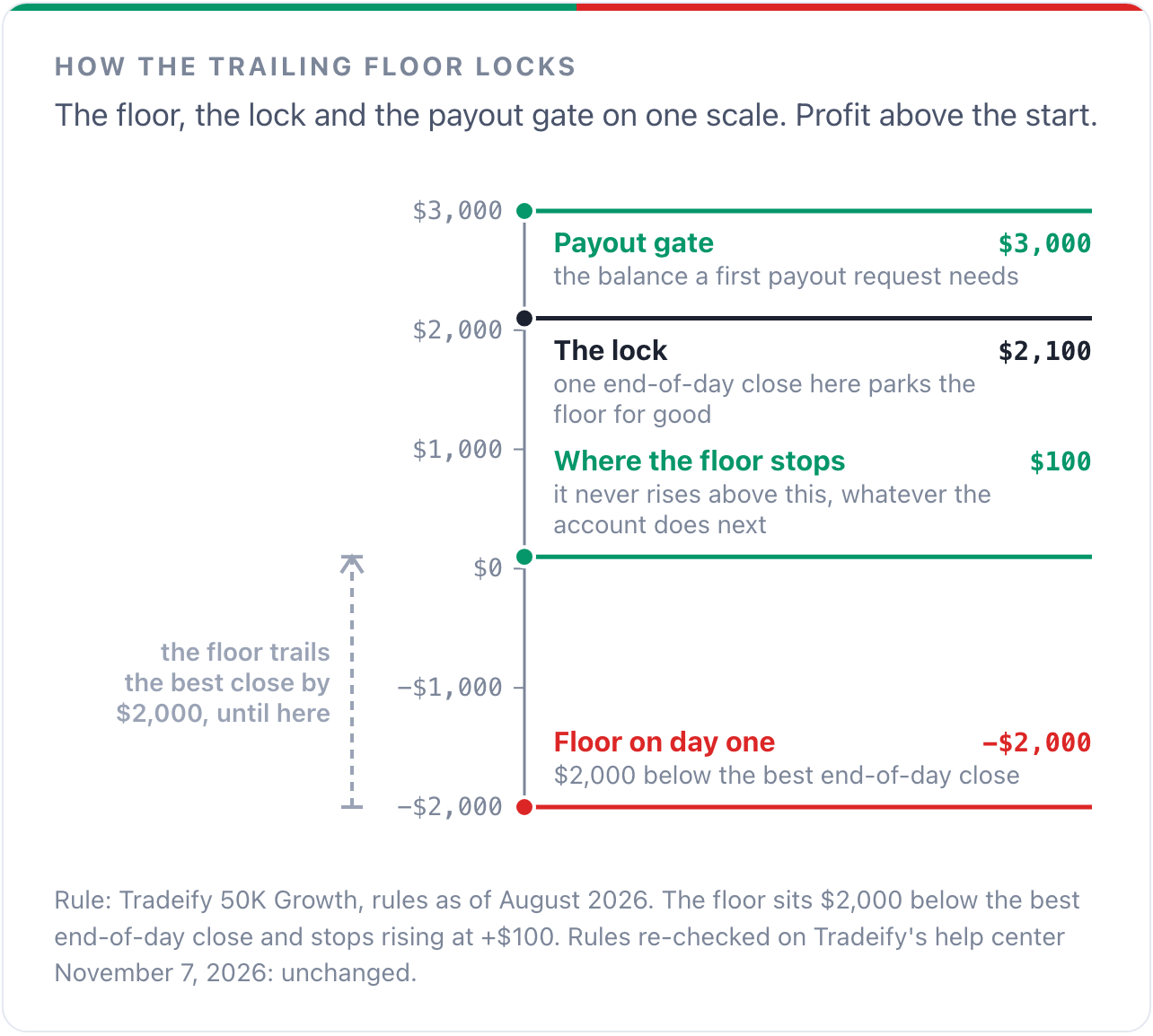
Quick recap from A prop account isn't one thing: the account dies at a floor that trails its best end-of-day close by $2,000, and the floor stops rising at +$100. (Tradeify 50K Growth, rules as of August 2026.) The first close at +$2,100 parks it there for good, payouts included. Re-checked November 7, 2026: the lock reads the same on Tradeify's drawdown page, an end-of-day balance of $52,100 fixing the floor at $50,100, and the page adds that a payout request locks it too, whichever comes first.
New posts land on Substack first. Free, one a week. The $20k test has a scoreboard, updated every Sunday.
Subscribe on SubstackBelow the lock, good days buy less room than they seem to
Before the lock, the gap between my balance and the floor can never be more than $2,000. A good day raises the balance and the floor together. After the lock, the gap is the balance minus $100. At +$3,000 that's $2,900 of room.
To see what that does over months, I ran one account through my simulator 60 times. Every run starts at +$1,500 with the floor still trailing. The dollars in this post come from my simulator, built on assumed win rates and payoffs (the A++, A and everything-else grades are working assumptions, and winners pay 1.2 to 3.6 times the risk), not from my journal.
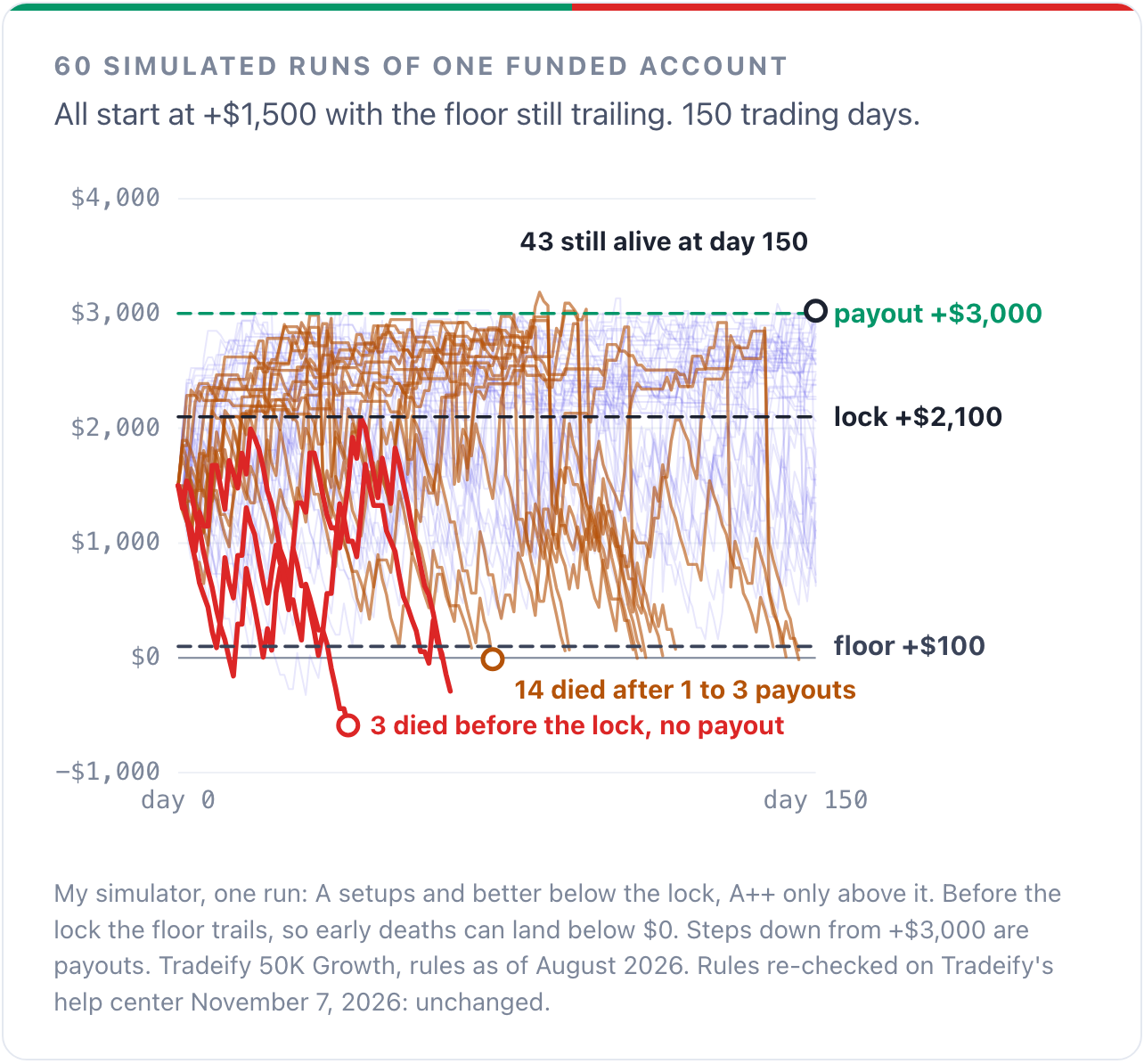
Before the lock, dying means walking away with nothing. After it, an account can still die, but by then it has usually paid me.
The later deaths have a cause too. A payout lowers the balance but not the floor, so every withdrawal moves the account closer to +$100. That's a price I'm happy to pay, because the money is already out.
So the question before the lock is whether the account survives long enough to pay at all. After the lock, the question is how many payouts it delivers before it runs out of room.
The lock splits a funded account into two jobs, surviving to +$2,100 and collecting after it.
Where the value jumps
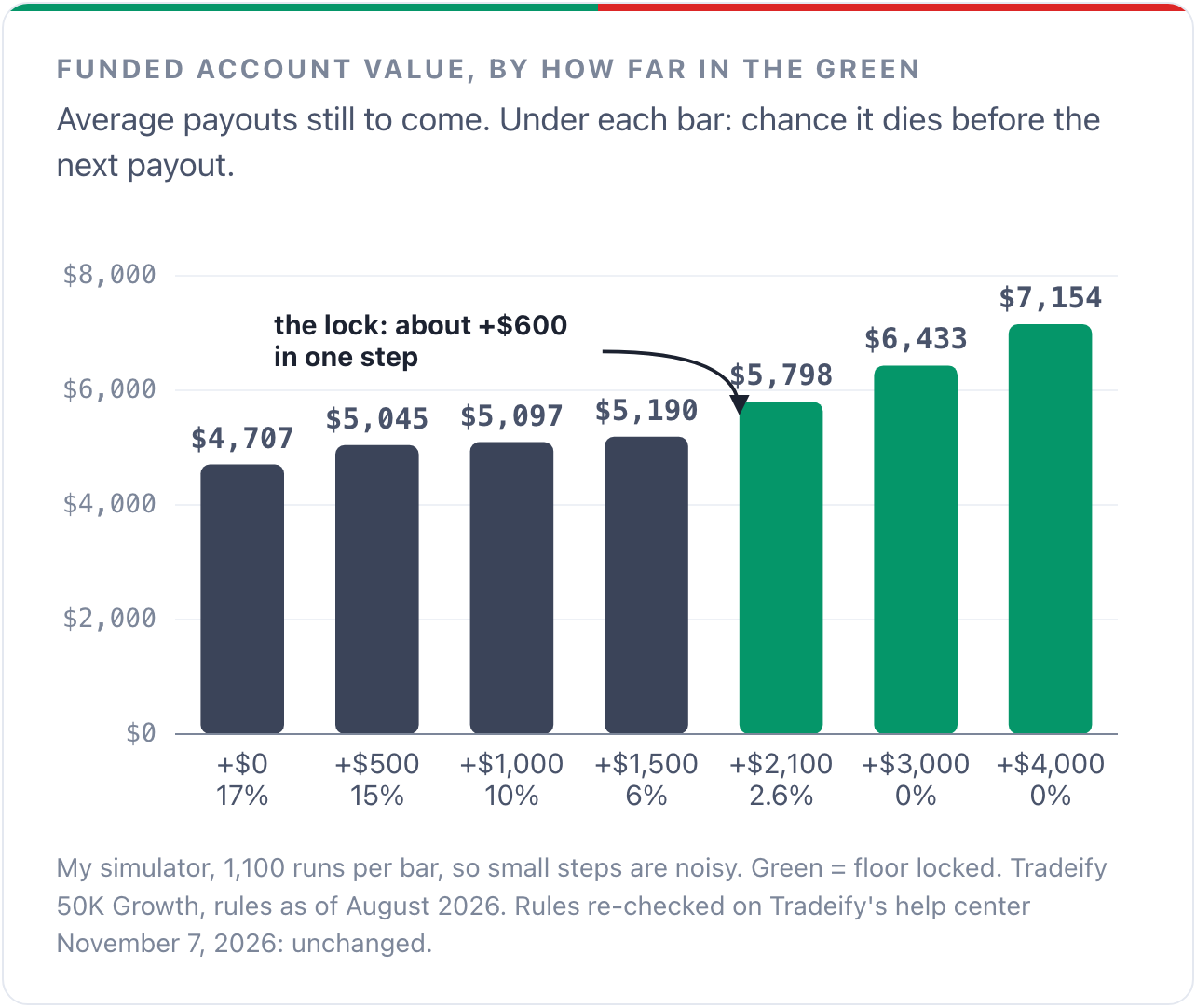
The risk of dying falls steadily as the cushion grows. The value doesn't. It jumps at the lock.
What I do now
- Below +$2,100, the job is one close at the lock. Moderate risk, A setups and better, no hero days.
- I treat the last $600 before the lock as the most valuable stretch in the account's life. A close at +$2,099 and a close at +$2,100 are different accounts.
- After the lock, I take my best setups only, sized so one win still makes a qualifying day (You can be too small to get paid).
- A payout doesn't restart the floor. Money I take out is mine. Money above +$100 is my buffer, and every payout makes it thinner.
Next: In an eval, risk buys time
New posts land on Substack first. Free, one a week. The $20k test has a scoreboard, updated every Sunday.
Subscribe on Substack