A prop account isn't one thing
What an eval, a funded account and a locked funded account are each worth to me, and how I trade each one.
I had three rules written down for trading prop accounts.
- Trade the eval with more risk.
- Treat a funded account that is $2,000 in the green like something precious.
- Get pickier about setups once the account is funded.
They were instincts. I couldn't have told you why they were right, so I built a simulator to check them. It backed all three, and for one reason.
A quick map if you've never done this. You pay a prop firm a fee and trade a test account called an eval. Hit the profit target without losing too much, and the firm gives you a funded account. Profits in a funded account can be withdrawn as payouts. Lose too much at any point and the account is gone.
This series takes one firm at a time. I'm starting with Tradeify and its 50K Growth plan, using its rules as of August 2026. Re-checked November 7, 2026: the $145 ticket, the $95 reset, the $2,000 end-of-day trailing drawdown, the +$2,100 lock and the 90% split all read the same on Tradeify's help center.
I also grade my setups: A++ for the best, then A, then everything below. Being picky is a dial, not a rule explains the grades.
New posts land on Substack first. Free, one a week. The $20k test has a scoreboard, updated every Sunday.
Subscribe on SubstackWhat I lose if it dies
That's the question I ask at every stage.
In the eval, very little. A Tradeify Growth eval is a one-time $145 purchase. If I blow it, a reset is $95.
In a funded account, I lose the account and every payout it would have paid me. My simulator plays an account forward thousands of times and averages the payouts. A fresh funded account comes out at about $4,700, after the firm's 10% cut.
One thing to hold onto for the whole series: every dollar value here comes from my simulator, built on assumed win rates and payoffs (the A++, A and everything-else grades are working assumptions, and winners pay 1.2 to 3.6 times the risk), not from my journal. The stage values below assume $250 of risk per trade in the eval, $150 a trade before the lock and $75 a trade after it. Change the size and the values move, and You can be too small to get paid shows by how much.
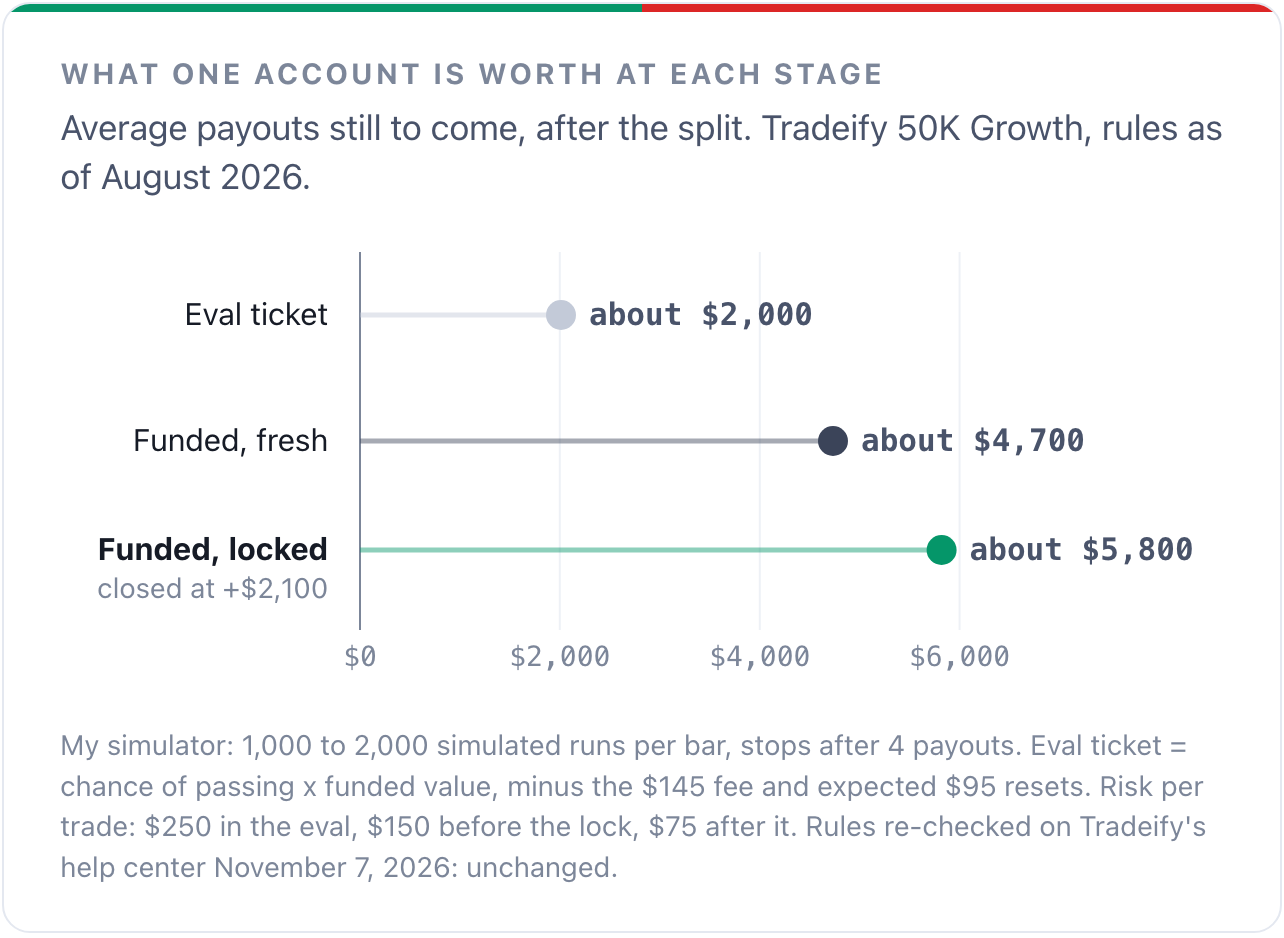
The floor that stops moving
The third bar is where the rulebook surprised me.
A funded account dies if its balance falls to a floor. The floor sits $2,000 below the account's best end-of-day close, so every good day drags it up behind you. That's the trailing drawdown. But the floor never rises above +$100. The first day the account closes at +$2,100, the floor parks at +$100 and stays there.
My "$2,000 in the green" instinct was, almost to the dollar, the firm's own switch. I call it the lock.
So one account has three stages, and each one asks for a different way of trading.
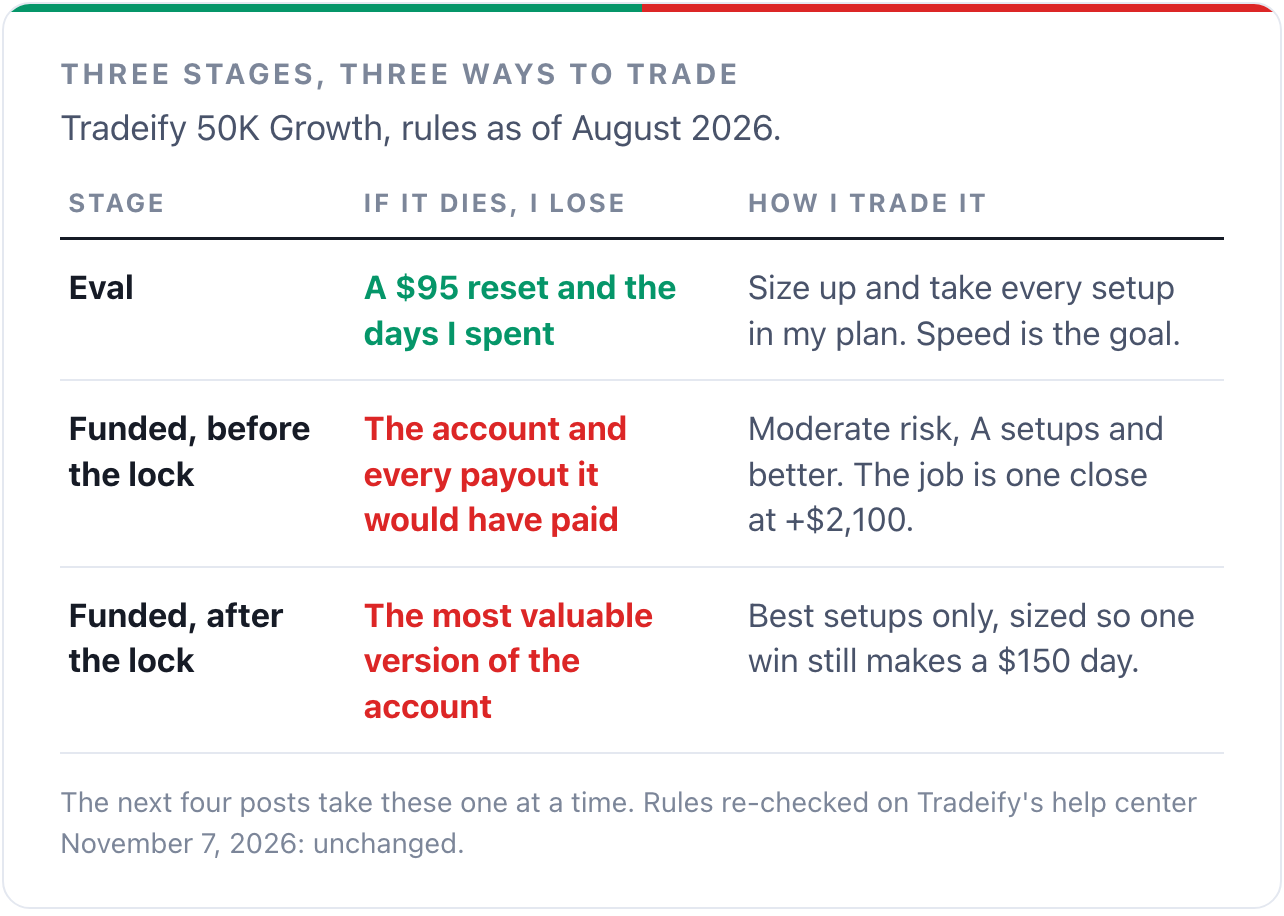
The same stop and target can be smart in an eval and careless in a locked account. A trade that is careful enough for a locked account can waste months in an eval.
Most prop-firm math grades one strategy against one firm. I think the unit that matters is the account's stage.
Where the series goes from here
The next four posts take one piece each.
- You can be too small to get paid: the payout rule that punishes trading too small.
- The $100 line that changes everything: the lock, and why the stretch just before it matters most.
- In an eval, risk buys time: why I size up when failing costs $95.
- Being picky is a dial, not a rule: how picky to be at each stage. That one closes out Tradeify.
Next: You can be too small to get paid
New posts land on Substack first. Free, one a week. The $20k test has a scoreboard, updated every Sunday.
Subscribe on Substack