In an eval, risk buys time
Why I size up in a Tradeify eval, even though more risk makes each ticket worth less on paper.
My calculator told me to risk $75 a trade in an eval. At $75, the median pass took 158 trading days.
That's more than seven months of mornings, spent protecting a ticket that costs $95 to replace.
I'd asked it for the most valuable ticket, when what I actually wanted was the fastest money.
New posts land on Substack first. Free, one a week. The $20k test has a scoreboard, updated every Sunday.
Subscribe on SubstackWhat an eval ticket is worth
An eval is the test account you trade to earn a funded one. As of August 2026, Tradeify's 50K Growth eval is a one-time $145 purchase with a $3,000 profit target. If you blow it, a reset is $95. Re-checked November 7, 2026: $145, $95 and the $3,000 target are unchanged on Tradeify's pricing page.
My calculator values a ticket like this. Take the chance of passing, multiply it by what a fresh funded account is worth (about $4,700 in my simulator, from A prop account isn't one thing), then subtract the fee and the resets you expect to pay along the way. Those values come from my simulator, built on assumed win rates and payoffs (the A++, A and everything-else grades are working assumptions, and winners pay 1.2 to 3.6 times the risk), not from my journal.
Small risk passes more often, so the ticket is worth more at $75 a trade than at $500. Every level is still worth far more than the $145 it costs, because the prize is big and failing is cheap.
A calculator that only looks at value picks $75 and stops there. Mine did.
The column I wasn't printing
Here is the same sweep, measured in days.
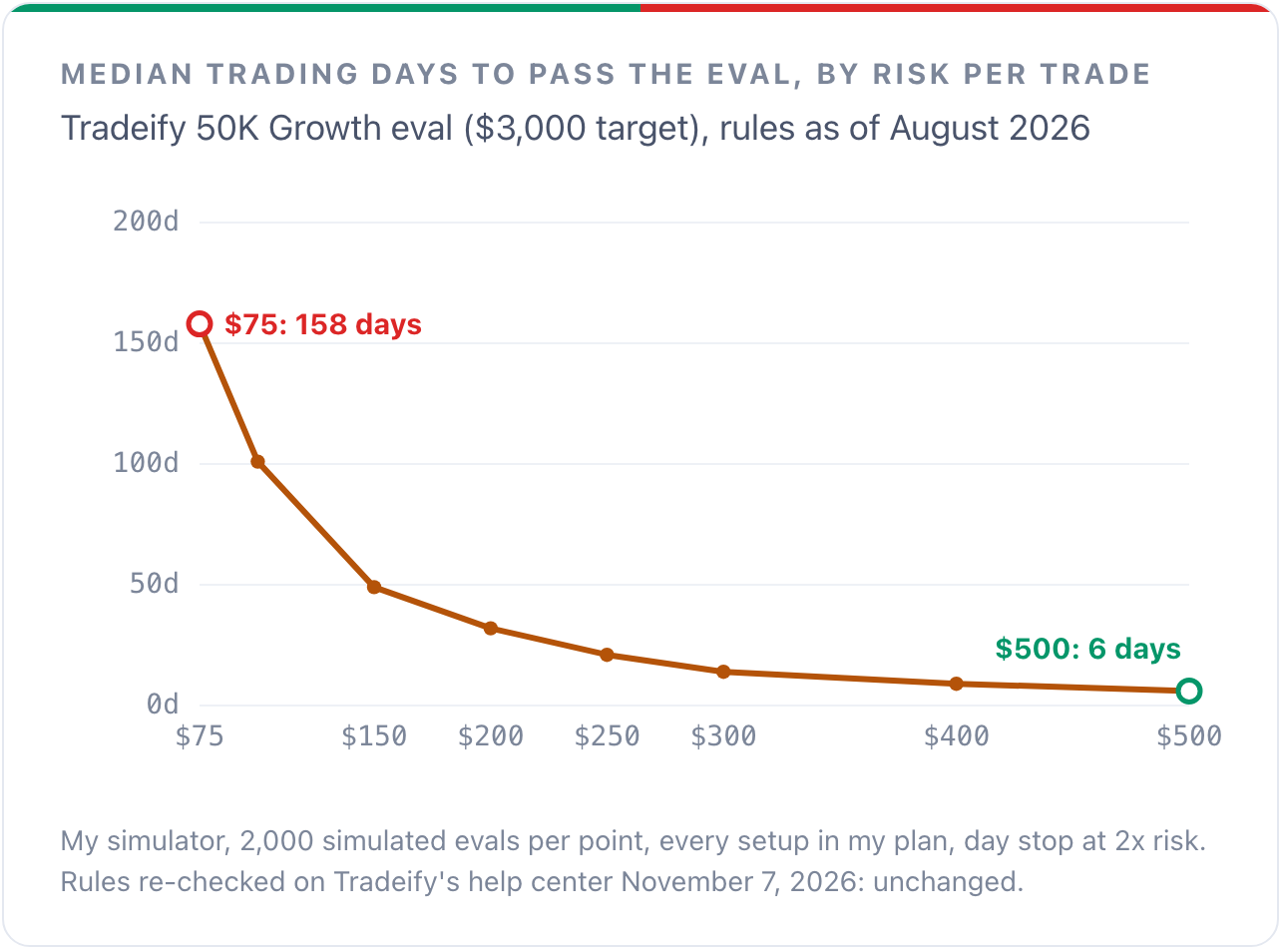
The pass chance does drop as risk goes up, from 76% at $75 to 40% at $500. But a failed eval at $500 costs me a $95 reset and a few mornings. A passed eval at $75 costs me more than half a year.
Every week I'm not funded is a week the funded account isn't paying me, and the funded account is where the value is. Grinding an eval at tiny risk protects a $95 reset and spends months.
So the calculator now divides the ticket's value by the days it takes to pass.
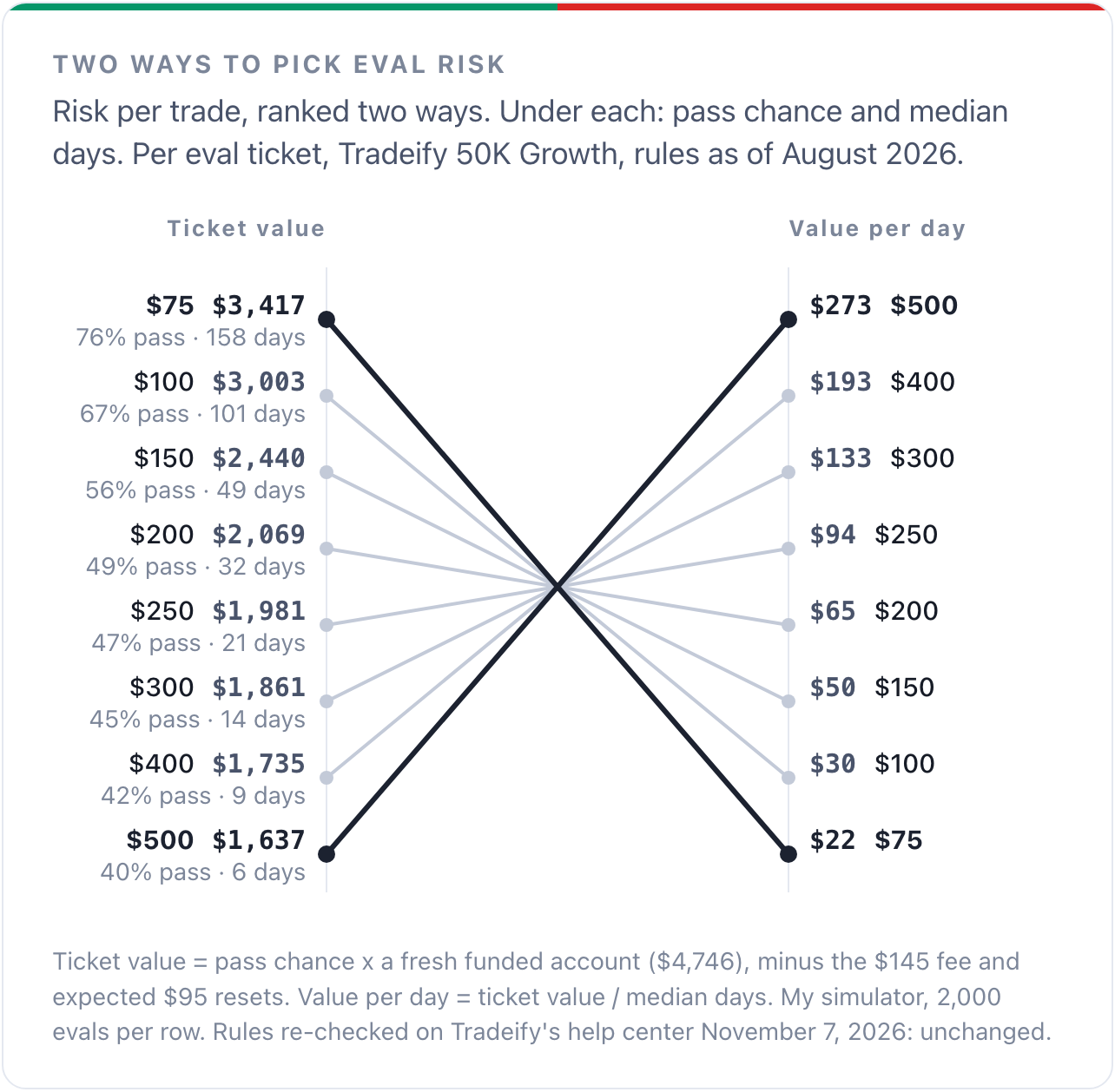
In an eval, more risk gives up some value on paper and buys a lot of time.
How I size an eval
- I size up in evals, toward the top of that range. My $1,000 daily max loss still caps the day.
- I don't carry this into funded accounts. There, dying costs thousands, and the same logic runs the other way (The $100 line that changes everything).
- I watch my own head. A reset is cheap in dollars, not in mood, and the calculator doesn't model tilt.
Next: Being picky is a dial, not a rule
New posts land on Substack first. Free, one a week. The $20k test has a scoreboard, updated every Sunday.
Subscribe on Substack