I only trade 9 to 11
Two hours on weekdays, a few hours on the weekend, and smaller size than I used to think I needed.
Key was sizing down. I trade 9 to 11 on weekdays and spend a few hours on the weekend reviewing. Neither works at big size.
At 9:00 I sit down with the bias already written and the overnight high and low already on the chart. At 9:30 the market opens and I wait for one trigger, in one direction. At 11:00 I close the platform, up, down or flat, and go to work.
New posts land on Substack first. Free, one a week. The $20k test has a scoreboard, updated every Sunday.
Subscribe on SubstackHaving somewhere to be is my best rule
My process is built for the open. The bias is set, the levels are marked, and I'm waiting for one kind of trade. I don't need the whole day for that.
The 11:00 stop also does a job no written rule could. I can't trade all afternoon to win back a bad morning, because I'm not there. Work starts, and the rule enforces itself.
The weekend is where the week gets graded
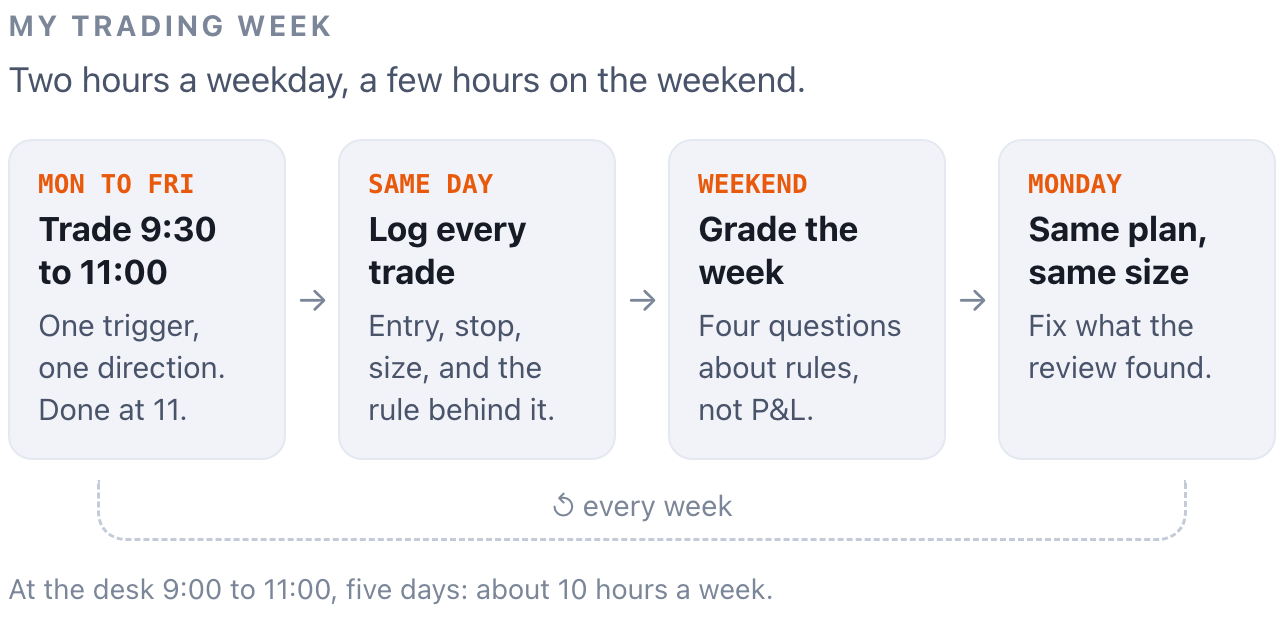
On the weekend I go back through every trade I took that week and ask four questions.
- Did it follow all three steps: bias, setup, trigger?
- Was it a trade or a move? A trade is one my rules called for. A move is one I took because price was going somewhere fast.
- Did the stop sit where the rules put it, just under the 15-minute higher low (or above the lower high)?
- Was the size right for the stop?
P&L isn't on the list. A green week full of chases fails the review. A red week where every trade followed the rules passes it. Ask yourself the same four questions about your last week before you look at the money.
Sizing down was the key
Take one trade with a 20-point stop. Each MNQ contract is $2 a point, so the loss is the number of contracts times $40. The setup is identical at any size. Only the cost of being wrong changes.
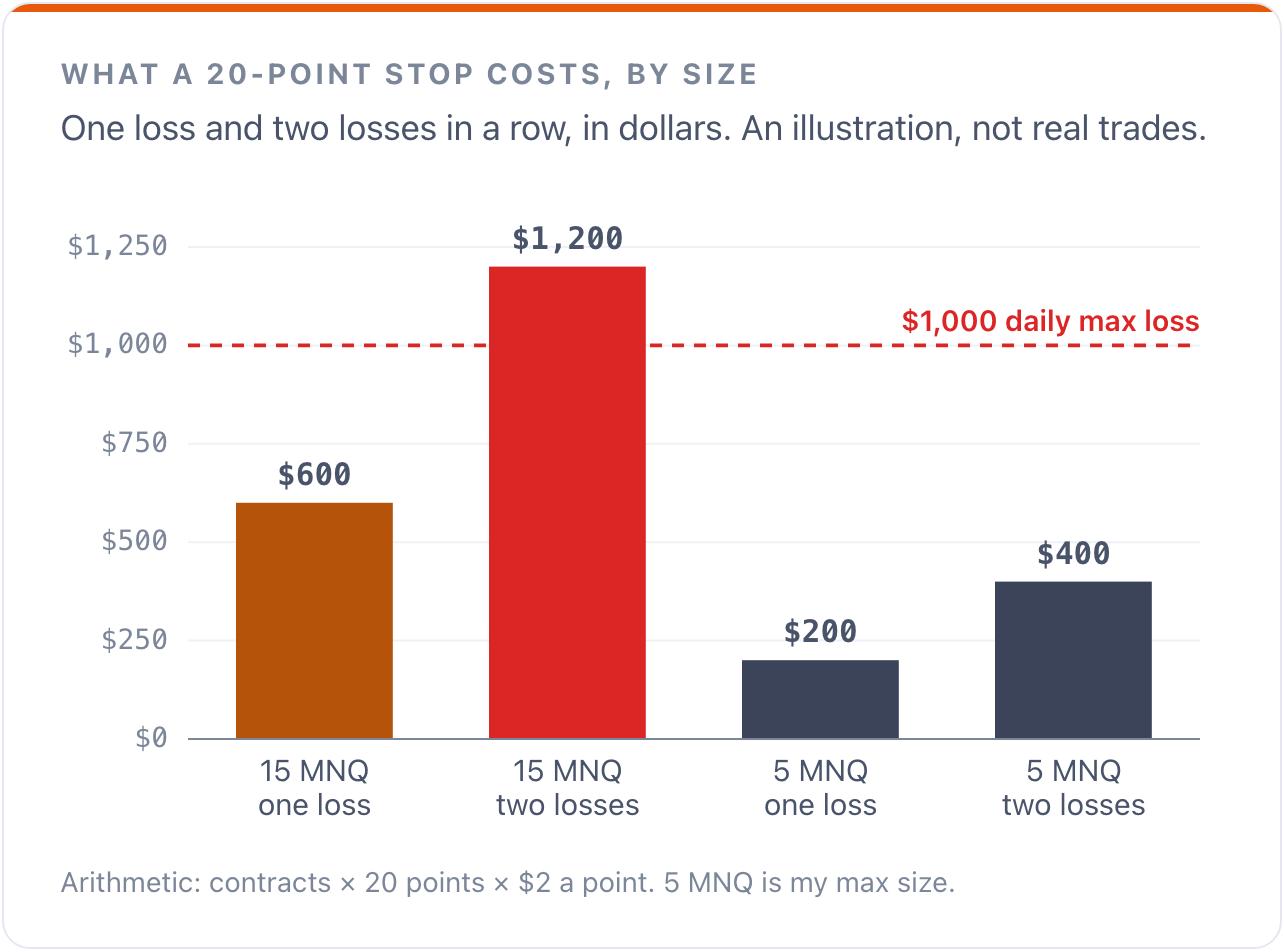
Two $600 losses before 10:00 is the kind of morning that makes you want it all back, right now, in one trade. That's tilt, and tilt ends prop accounts. Every day you don't tilt is a good day walks through what that morning does to an account.
Two $200 losses is a slow morning. I wait for the next trigger or log off at 11 and come back tomorrow with the same plan.
Once the losses are small enough to be boring, the rules get easy to follow.
So 5 MNQ is my ceiling on every trade, and if I catch myself wanting to size up after a loss, I stop for the day. Evals are the one place I push risk up, because losing one costs a $95 reset (as of August 2026). In an eval, risk buys time has that math.
It also changed what a good day looks like. A few hundred dollars a day, repeated, adds up faster than it sounds. $500 a day is a lot of money has the arithmetic.
Next: Every day you don't tilt is a good day
New posts land on Substack first. Free, one a week. The $20k test has a scoreboard, updated every Sunday.
Subscribe on Substack