At Vest, skip the instant account
Why a $75 evaluation buys more than a $200 instant account at the same $5,000 size.
On a Vest Markets instant account, the fee and the loss limit are the same number. $200 buys a $5,000 account that closes when it's down $200. $1,000 buys a $25,000 account that closes at $1,000 down.
That's dollars for dollars. If that's the deal, the money belongs in a real brokerage account.
I don't trade Vest. I researched it for this series because its accounts show one thing about prop firms very clearly: the fee and the loss limit are the two numbers to compare. The numbers below come from Vest's own site, checked November 6, 2026 and again the next day. Prices change, so check before you buy.
New posts land on Substack first. Free, one a week. The $20k test has a scoreboard, updated every Sunday.
Subscribe on SubstackTwo ways to buy the same $5,000
Vest Markets is one of the newer prop firms. Its site lists stocks, commodities and crypto, traded as derivatives, and profits settle in USDC, a dollar stablecoin.
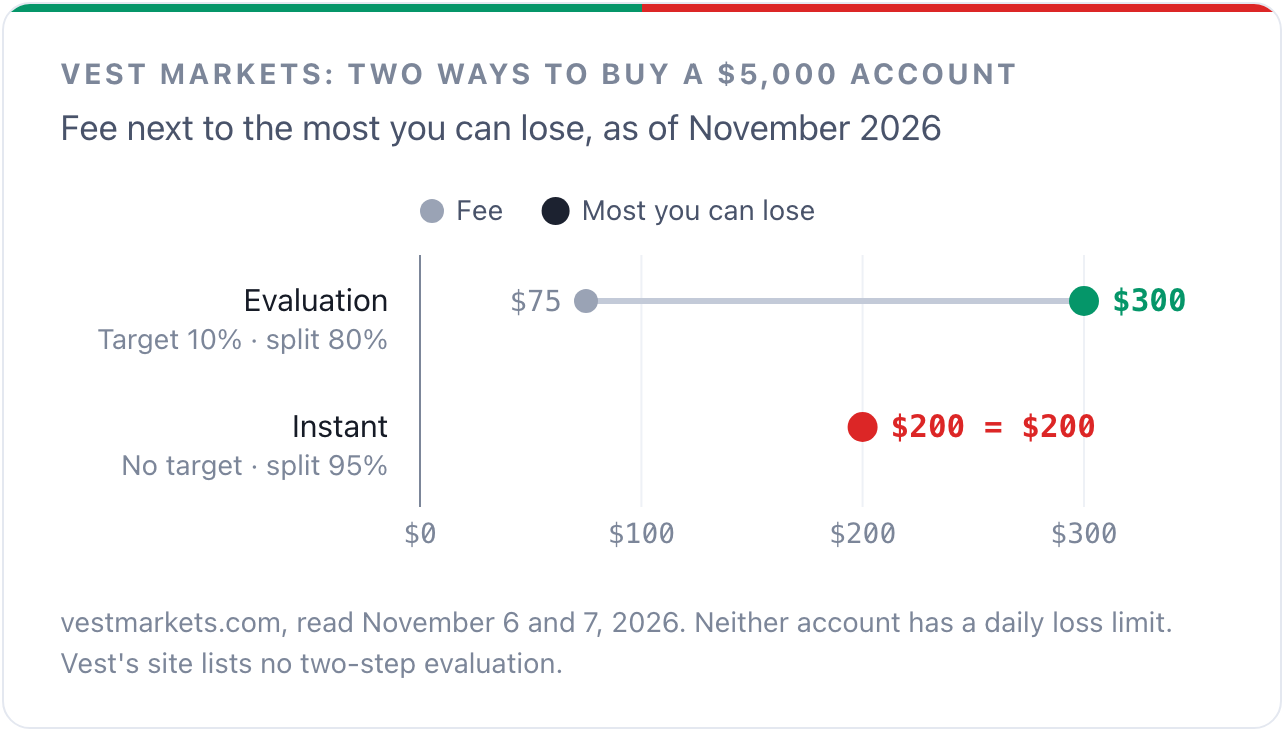
The evaluation makes you hit a 10% profit target before you get paid. Its loss limit is $300, with no daily limit. You keep 80% of profits.
The instant account has no target and no daily limit, and you keep 95%. You pay for that with the fee.
The fee is the loss limit
Put the same $1,000 in two places and follow it.
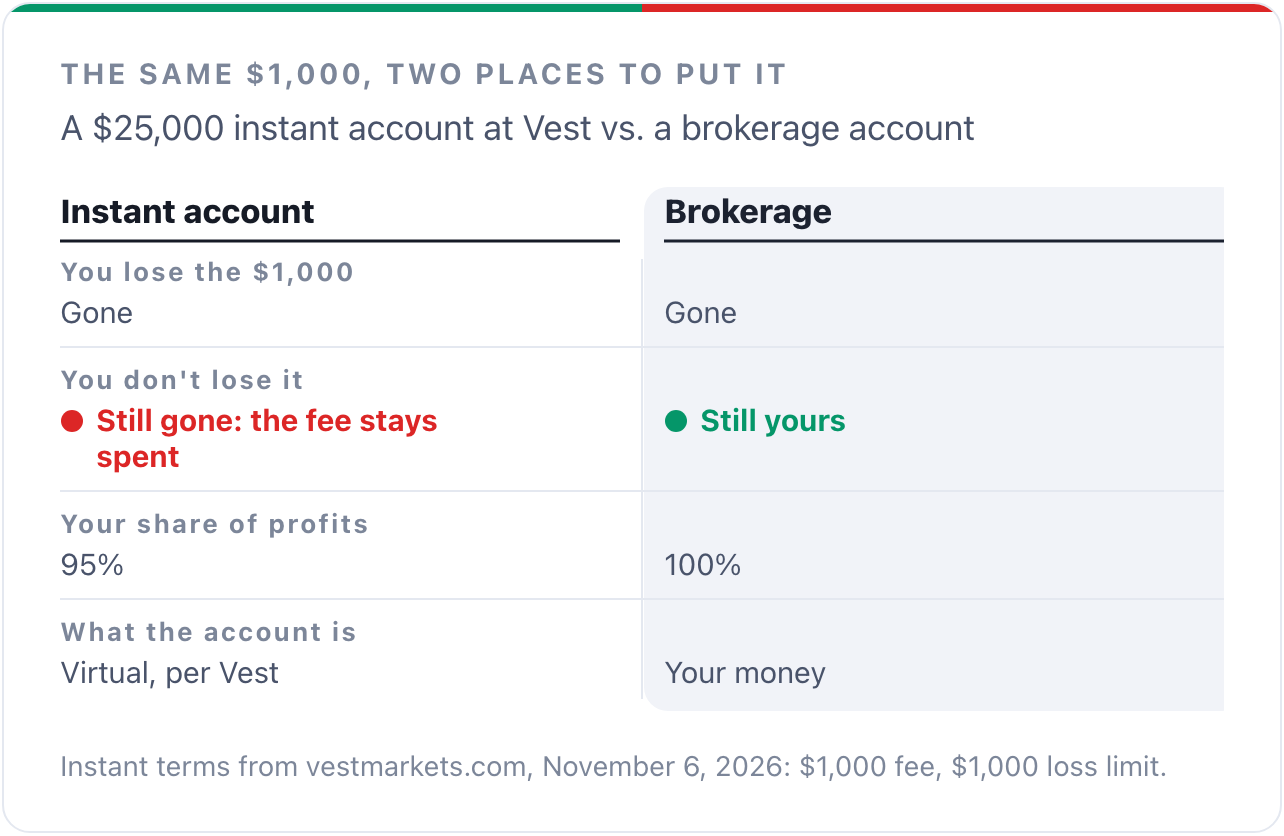
What the instant account mostly sells is convenience, a big account size on your screen. A broker can give you size through leverage, without a fee you never see again.
The evaluation is where the leverage is
Divide the loss limit by the fee. That's how many dollars of room to lose each dollar of fee buys.
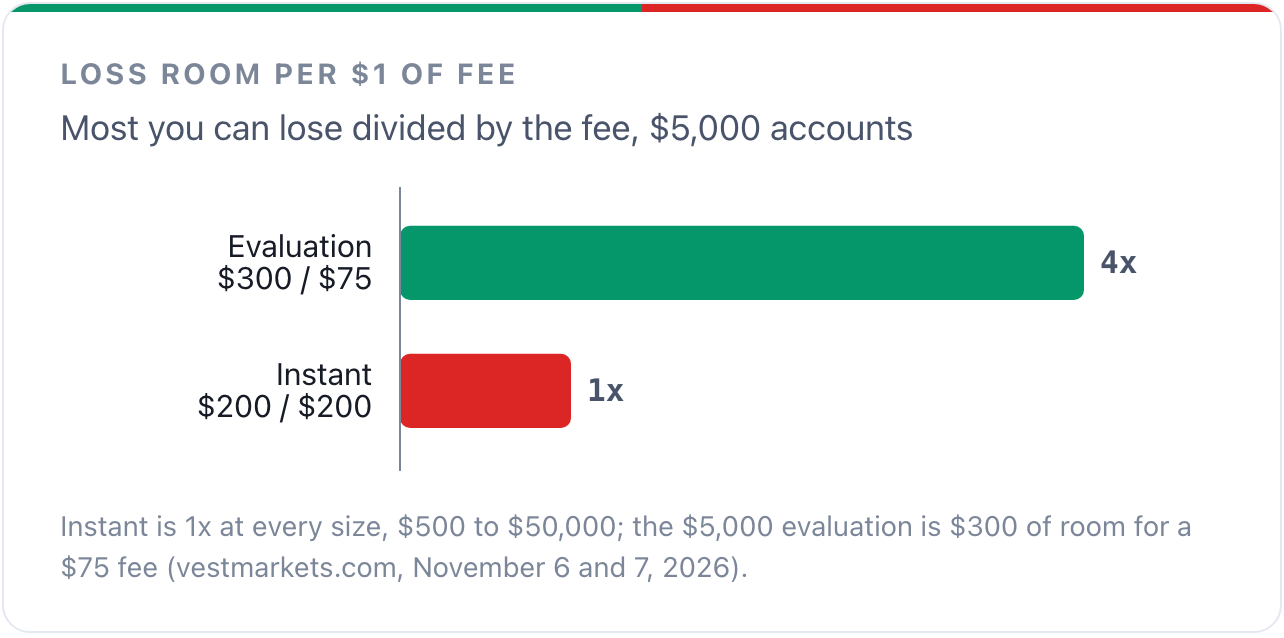
What you pay for that leverage is the target. You have to make 10% without breaking the loss limit. A trader who keeps losses small can do that. A trader who tilts can't, no matter how many evaluations they buy. (More on that in Every day you don't tilt is a good day.)
How I'd use Vest
Ask yourself what you're paying for before you pay it.
- Skip the instant account. If you want to risk your own dollars one for one, put them at a broker, where the dollars you don't lose stay yours.
- Treat the evaluation fee as the whole risk: $75 to find out whether your trading is good enough right now.
- Trade it with the same small, boring risk you use everywhere else. One good day at a time, not one big day. That's $500 a day is a lot of money.
- Read the terms. Vest's own disclosures say instant accounts and their balances are virtual.
Two of the firms I trade, and one I looked at and walked past. From here the publication turns to the attempt to take myself out of it: a bot that trades the plan while I'm at work.
Next: I checked 1,465 live trade calls against the tape. 5 in 6 were honest.
New posts land on Substack first. Free, one a week. The $20k test has a scoreboard, updated every Sunday.
Subscribe on Substack