A tech job, two hours a day, and a trading bot
Where I started, what broke, and what I'm testing now.
I trade NQ futures by hand, mostly the micro contract (MNQ), from the open at 9:30 Eastern until about 11:00. Then I close the laptop and go sell software. I work in tech sales full time.
Two hours isn't a lot. So from day one I wanted a bot that trades my plan without me. This page is the short version of how that's going, in the order it happened. The four series of the newsletter follow the same order: how I trade, where I trade it, the attempt to automate it, and the $20k test running now.
How I trade
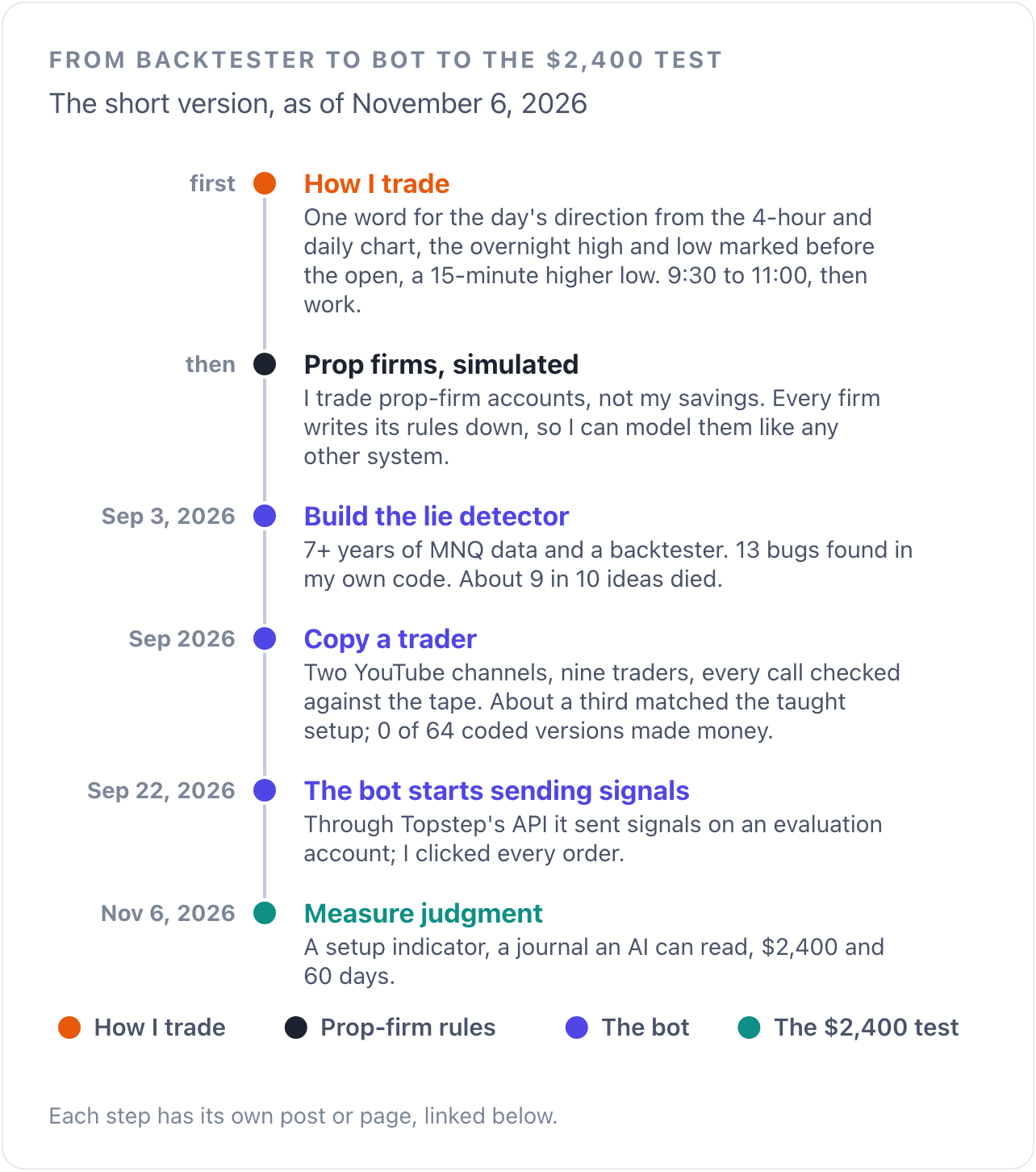
The method came before any of the tools. One word for the day's direction from the 4-hour and daily chart, the overnight high and low marked before the open, and a 15-minute higher low (or lower high) as the only trigger. Done at 11:00, win or lose. Four hard rules cap the size. I was trading it this way last year, before I wrote a line of code for any of what follows.
Why prop firms
I don't trade my savings. I trade prop-firm accounts. You pay a fee to take an evaluation, a test with a profit target and a loss limit. Pass it, and the firm funds an account and splits the profits with you.
For someone with a day job, that's the right shape. The most I can lose on an account is what I paid for it. And every firm writes its rules down, which means I can model them like any other system. In July 2026 I built a simulator that plays a Tradeify account forward thousands of times; the prop-firm rules series comes out of it. I use Tradeify, Topstep, Lucid and MyFundedFutures. In early November, MyFundedFutures paid me $2,400, my 80% cut of $3,000 in profit.
Step 1: I built the lie detector first
Before I wrote a strategy, I built the tests.
I bought more than seven years of real exchange data for MNQ. I built a backtester, a program that replays the past and trades a strategy on it, with real costs and fills that assume the worst. Then I hunted for bugs in my own code. I found thirteen. One of them made my best strategy look about 15% better than it was.
Then every idea went through the same tests. More than 20 went in. About nine in ten died. The one the bot trades is a morning breakout with one filter, held into the close. Its live record is small, so I don't call it an edge.
Along the way, I built a levels indicator for TradingView and licensed it to the trader whose method it draws. It passed 1,000 lifetime users. The first 95% came together fast. The last 5% took weeks of tuning by hand. Same lesson for the bot: the first 95% is fast, the last 5% is the job.
Step 2: I tried to copy a trader
I downloaded the archived livestreams of two YouTube channels where nine traders call their entries on air, turned the speech into text, pulled out every trade they called, and checked each one against real price data. Then I coded the one setup they teach and tested 64 versions of it with honest fills. None of them made money.
Only about a third of the calls matched the taught setup. The rest were judgment: a level someone liked, a read on the day.
A bot can only copy the part of a method a trader can say out loud.
Step 3: the bot starts sending signals
I started with Topstep because it has a real API, a door that lets my own program talk to the account. I wrote the bot against it. On September 22, 2026 its first signals went out on an evaluation account, with my click on every order. It never places an order by itself. It trades the morning breakout and holds into the close; the 11:00 stop is for my hand trades.
Then I read the fine print. Topstep's API has to run from your own computer, and it stops working once you reach a Live Funded account. Lucid welcomes automation but has no API of its own.
Where I was on November 6: the $2,400 test
So I stopped trying to replace judgment and started measuring it.
I trade the setups myself, with a setup indicator I built in TradingView. It sets my bias from the 4-hour and daily charts, marks the levels I care about, and calls each setup as it forms: A+, B, or no trade.
As a fixed set of rules, it breaks even: 236 A+ trades over five years, half of them winners, an average just under zero. That's the starting line. On November 6, 2026 I put the $2,400 payout behind it, gave it 60 days, and wrote the scoreboard down before the first trade. The readout comes in early January, good or bad.
Where I am now: the $20k test
Three days in, I changed the test. Looking at five years of my level setups next to one number, how far price was from yesterday's close at entry, the losses all sat close to it and the profits all sat away from it. So the indicator under test is now a single rule, no level trades while price is inside a VIX-sized zone around yesterday's close, on one instrument, MNQ, for two months, with one number on the wall: $20,000 by the close on January 8, 2027. For the test the window is wider than my usual two hours, entries until 15:30 and flat by 16:10, because that is when these setups fire. The starting line has the numbers; the scoreboard is updated every Sunday.
What the loop does each week
- A journal that checks me. Every trade lands in my journal tagged with what the indicator said at that moment. Did I take the A+? Skip the off-plan ones? Exit where the plan said?
- One change a week. An AI reads the week's trades from the journal, lines them up with the indicator, and proposes one change. I write the test down first and keep the change only if it beats the current version on five years of history and on the live trades.
- The value of a setup, before I take it. Years of past setups, scored by how they actually turned out, so the chart can show what a setup like this one is worth on average. Only when there's enough history to trust the number.
The rules that keep it a side project
- $1,000 max loss per account per day.
- Max 5 MNQ per trade.
- One account per firm until I have $100k liquid.
- Two hours, then work.
Read the steps in full
- Start here
- My strategy fits on a sticky note
- A prop account isn't one thing
- I checked 1,465 live trade calls against the tape. 5 in 6 were honest.
- I coded a YouTube trader's setup. Zero of 64 versions made money.
- The firm with the API isn't the firm that allows the bot
- My indicator breaks even. I gave it $2,400 and 60 days to get better.
- The loop: one 15-minute bar in, one indicator change out
- I'm changing the test. One indicator, one instrument, two months, $20,000.
- Thirteen trades won't tell me if it works. Following the rules will.
New posts land on Substack first. Free, one a week. The $20k test has a scoreboard, updated every Sunday.
Subscribe on Substack