Start here
I trade futures for two hours before work and I'm trying to get a bot to do it for me. This is where I show the math, the process and the code, including the parts that don't work.
Scoreboard as of November 7, 2026: week 0 of 9, 0 changes kept, $0 of $2,000 spent.
I trade NQ futures, mostly the micro contract (MNQ), from the open until about 11:00 Eastern. Then I log off and go to my day job in tech sales. Trading has to fit into those two hours, and it has to survive on rules, because I can't watch a screen all day.
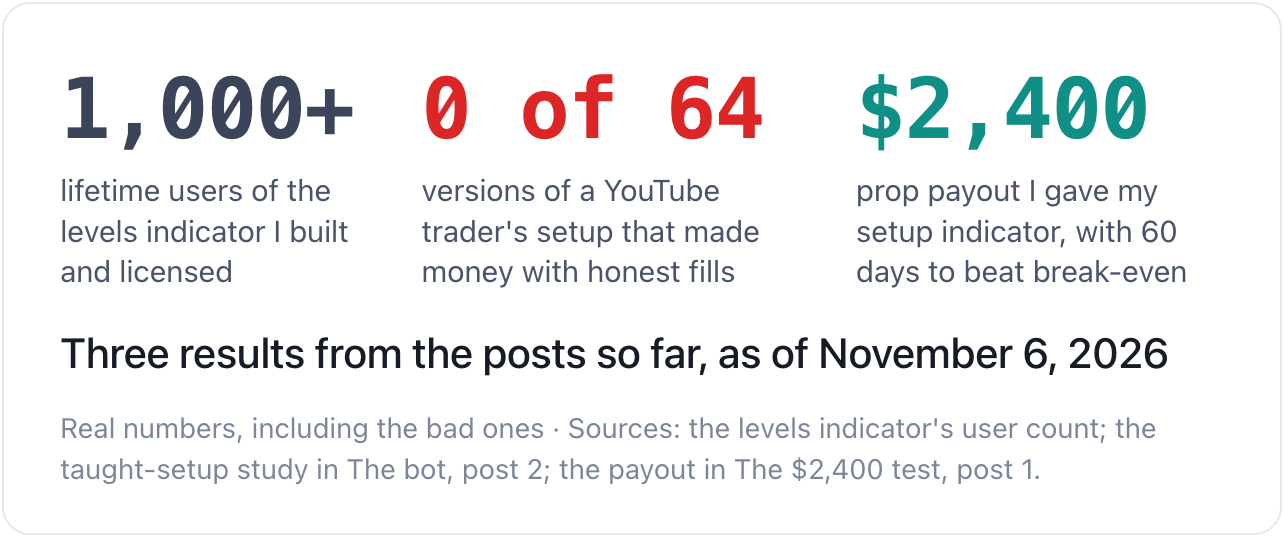
So I treat trading like a system. I write the rules down, I measure them, and I build tools when the numbers say I should. Some of those tools worked out. I was drawing my levels by hand every morning, using another trader's method. I knew a computer could do it, so I built one that did, licensed it to him, and it passed 1,000 lifetime users. Others haven't. The setup indicator I'm testing right now shows no edge yet, and I'll show you that number too.
New posts land on Substack first. Free, one a week. The $20k test has a scoreboard, updated every Sunday.
Subscribe on SubstackWhat to expect
- One long post a week, rotating through the series.
- A short week-in-review most Fridays: what I traded, what the rules said, what happened.
- Real numbers, including the bad ones. If a strategy fails a test, you'll see the test.
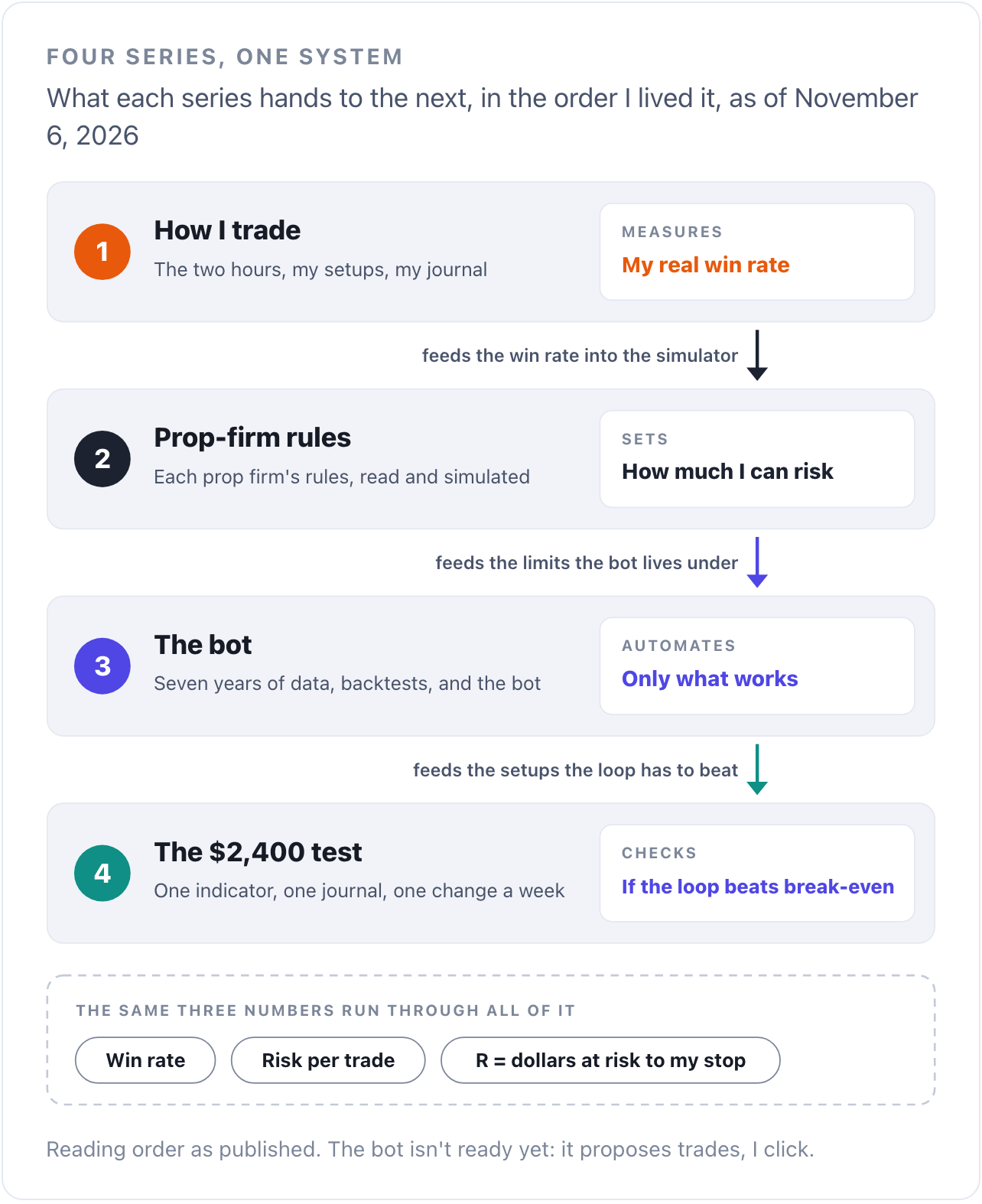
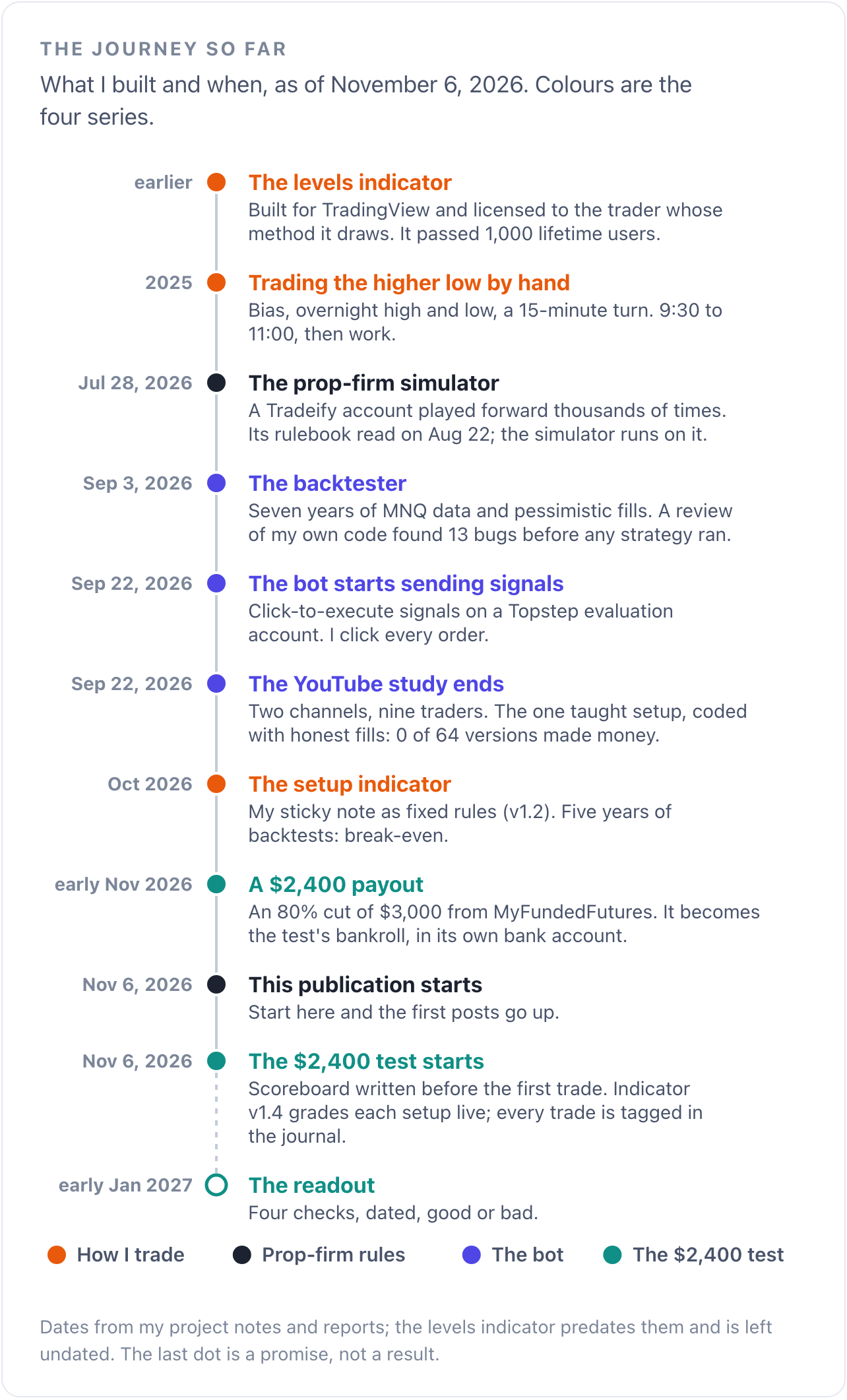
This publication has four series. They look like different topics, but they're one system, and they're in the order I lived it.
1. How I trade
How the two hours actually work. What I do before the open, the setups I take and the ones I skip, the hard rules that keep a bad morning from becoming a bad month, and how I log every trade so the numbers in series 2 are mine, not guesses. The story of the levels indicator, and what the last 5% of building it taught me, is on the About page.
2. Prop-firm rules: how to trade each firm differently
Prop firms sell you an evaluation, and if you pass, they fund an account and split the profits. Every firm writes different rules: trailing drawdowns, daily loss limits, consistency rules, payout gates. Most traders pick a firm by price and trade it the same way they'd trade anything else.
I don't think that works. A prop account is a different asset at each stage of its life. What the eval is worth, what a fresh funded account is worth and what a funded account $2,000 in the green is worth are three different numbers. How much I risk and which setups I take should change with them. I start with one firm, Tradeify, and simulate its whole life. Then I read the rules at the other firms I use or looked at, and say what I'd buy. I use Tradeify, Topstep, Lucid and MyFundedFutures.
3. The bot
The part of me that only has two hours a day wants a bot that trades the plan without me. This series is the build log: seven years of MNQ data, backtests, the bugs that made bad strategies look good, the statistical tests that tell me when a result is luck, and a bot that sends signals on an evaluation account while I click every order. The goal is not one perfect strategy. It's a set of rules-based strategies whose results don't move together, spread across firms, so no single bad week decides everything.
4. The $2,400 test
The part that is happening now. On November 6, 2026 I set aside a $2,400 prop payout and gave my setup indicator 60 days to get better than break-even. The first post is the kickoff, with the scoreboard written down before the first trade. The second draws the whole loop, from the indicator on TradingView to my journal and back. The readouts come in January, dated, good or bad.
How it fits together
All four series run on the same numbers: win rate, risk per trade, and R (the dollar distance to my stop). The firm's rules decide how much I can risk. My journal measures the win rate. The bot tries to automate what the journal shows actually works. The Tradeify calculator and its charts live at stockmarketelephant.com, where you can change the inputs and run the simulations yourself.
Where to start
Read it in the order below, the order I lived it. If you only came for one part: new to prop firms, go to Prop-firm rules; already trading, start with How I trade; here for the bot, The bot; here to watch something happen, The $2,400 test.
1. How I trade
- My strategy fits on a sticky note
- I only trade 9 to 11
- Every day you don't tilt is a good day
- Was it a trade or was it a move?
- $500 a day is a lot of money
- Wait for the higher low
2. Prop-firm rules
- A prop account isn't one thing
- You can be too small to get paid
- The $100 line that changes everything
- In an eval, risk buys time
- Being picky is a dial, not a rule
- At Lucid, buy the Flex
- At Vest, skip the instant account
3. The bot
- I checked 1,465 live trade calls against the tape. 5 in 6 were honest.
- I coded a YouTube trader's setup. Zero of 64 versions made money.
- The firm with the API isn't the firm that allows the bot
4. The $2,400 test
- My indicator breaks even. I gave it $2,400 and 60 days to get better.
- The loop: one 15-minute bar in, one indicator change out
Next: My strategy fits on a sticky note
New posts land on Substack first. Free, one a week. The $20k test has a scoreboard, updated every Sunday.
Subscribe on Substack